
|
Getting your Trinity Audio player ready...
|
Even as the AI-fueled stock rallies that swept through North Asia earlier this year have turned choppier, the wealth those rallies created is still working its way through the region’s economies, and nowhere is that more visible than at the jewelry counters, watch boutiques and luxury department stores of Seoul and Tokyo. Affluent consumers in South Korea and Japan are continuing to spend heavily on high-end goods months after chip stocks first surged, evidence that the AI boom’s economic reach extends well beyond trading screens.
South Korea offers the clearest example. Samsung Electronics, SK Hynix and other domestic technology firms drove one of the country’s most dramatic stock-market rallies in years earlier this year, and while markets have since turned considerably more volatile, consumer spending has held up more durably than the underlying share prices. Rajiv Biswas, CEO of Asia-Pacific Economics, attributed the resilience to a combination of factors, telling Business Insider that strong tech-sector revenues drove large bonuses and dividend payouts, while the broader wealth effect from rising stock prices helped lift household consumption through the first half of 2026.
That spending pattern has not moved in a straight line. Morgan Stanley’s chief Korea and Taiwan economist, Kathleen Oh, noted in a September 17 report that Korean consumer spending slowed in July before rebounding in September, a dip she tied partly to the market swings hitting tech shares over the summer, while adding that underlying confidence in the broader spending recovery has remained largely intact. On the strength of that resilience, Morgan Stanley raised its forecast for South Korea’s private consumption growth this year to 2.6 percent, up from an earlier estimate of 2.2 percent, citing stronger household incomes, fiscal support, rising asset wealth and a pickup in inbound tourism.
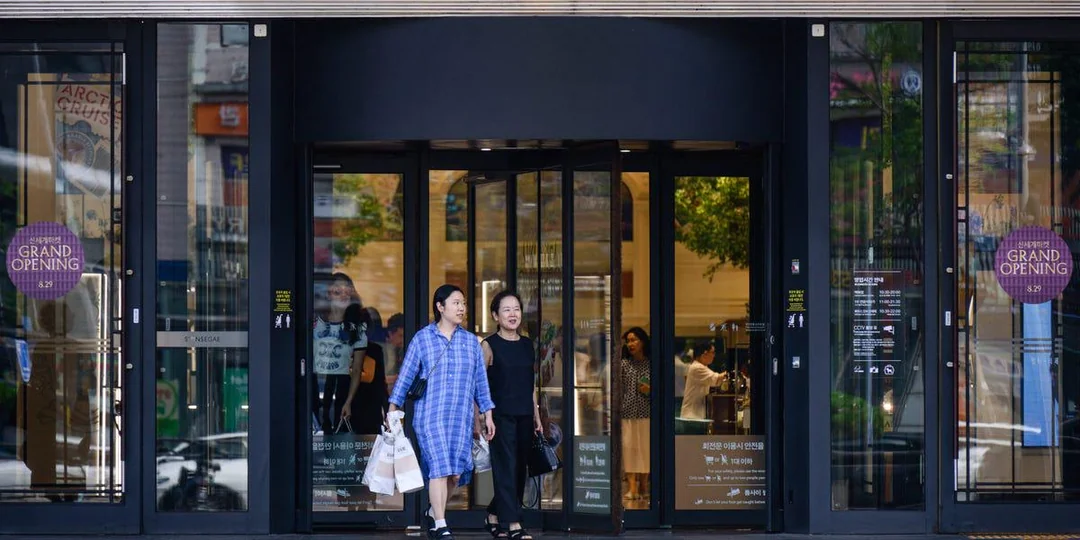
The clearest evidence of that spending shows up directly in department store results. At Shinsegae, one of South Korea’s largest high-end department store operators, same-store sales climbed 15 percent year over year in August, according to Bank of America, with luxury-specific sales up 20 percent and revenue from international customers jumping 82 percent. Bank of America’s analysts noted this pattern is consistent with prior market cycles in Korea, where department store sales tend to track increases in household equity holdings with roughly a one-year lag, suggesting the current spending strength may partly reflect gains locked in earlier in the rally rather than real-time market performance.
Global luxury brands have felt the same tailwind. LVMH reported strong first-half growth across Asia outside Japan, with the company’s leadership specifically pointing to the performance of Louis Vuitton’s newer stores in Seoul and Beijing as a factor behind faster growth in the second quarter. Richemont, which owns Cartier and Van Cleef & Arpels, reported Asia-Pacific sales rising 21 percent in the quarter ending in June, with South Korea and Taiwan ranking among its strongest markets globally. Even so, the latest figures suggest that blockbuster first-half pace has started cooling. JPMorgan analysts wrote in a September 18 report that demand is no longer uniformly strong across the category, though they stopped short of describing it as breaking down, noting that jewelry, watches and top-tier luxury brands have held up considerably better than broader luxury categories as market volatility has increased since July.
Stock market gains represent only one channel through which South Korea’s AI-driven wealth is reaching households, and Morgan Stanley expects that broader distribution to strengthen further in the years ahead. The bank’s economists described Korea as positioned to monetize its current semiconductor windfall on a scale and with a durability rarely seen historically, projecting the benefits will spread through investment, government finances and household income over the next three to five years. Employee compensation stands out as one particularly direct channel. Morgan Stanley estimates that Samsung Electronics and SK Hynix could together generate roughly 66.7 trillion won, or about $49 billion, in combined gross employee compensation this year, climbing to 107.6 trillion won in 2027 and 114.9 trillion won by 2028. The bank separately projected that average annual liquid bonus capacity between 2026 and 2028 could reach roughly 20 times 2025 levels, giving Korean tech workers a meaningful new source of spending power even if broader stock market gains prove less reliable going forward.
Japan’s version of this story has played out with a somewhat different character. High-end retailers there are also benefiting from a strong domestic stock rally driven substantially by AI-linked chip and equipment makers, with Takashimaya, one of Japan’s largest luxury department store chains, reporting in-store sales up 3.9 percent year over year in August. Richemont’s Japanese sales surged 36 percent in the quarter ending in June, and Hermès reported an 11 percent increase in first-half Japanese sales at constant exchange rates, with both companies crediting a mix of domestic shoppers and returning tourists. Biswas cautioned that the AI wealth effect is likely to remain more muted in Japan overall than in Korea, pointing out that most Japanese households hold comparatively little direct stock market exposure and have traditionally favored low-risk fixed income assets over equities.
Taiwan offers a longer-running preview of where this dynamic can eventually lead. Around Hsinchu Science Park, home to TSMC and hundreds of companies across its semiconductor supply chain, years of accumulated chip wealth have steadily fueled demand for housing, luxury retail and premium services in the surrounding area. Former farmland near the park has given way to luxury apartment towers over the past several years, and local home prices have climbed well beyond what many longtime residents can afford, illustrating how concentrated tech wealth can reshape a regional economy over a longer timeframe than the more recent Korean and Japanese rallies have had to play out.
Whether South Korea and Japan’s luxury spending strength continues tracking the more volatile path of AI-linked chip stocks, or increasingly decouples from day-to-day market swings as bonus payouts and broader income gains take over as the primary driver, will likely become clearer over the coming quarters as Morgan Stanley’s multi-year projections for Korea’s semiconductor windfall begin playing out in earnest. Continuing coverage of how the AI boom is reshaping consumer spending and wealth across global markets is available on Business Tech. Additional detail on luxury sector performance in the region is available through LVMH’s official site, and further reporting on the underlying trend can be found through Business Insider’s original coverage.