|
Getting your Trinity Audio player ready...
|
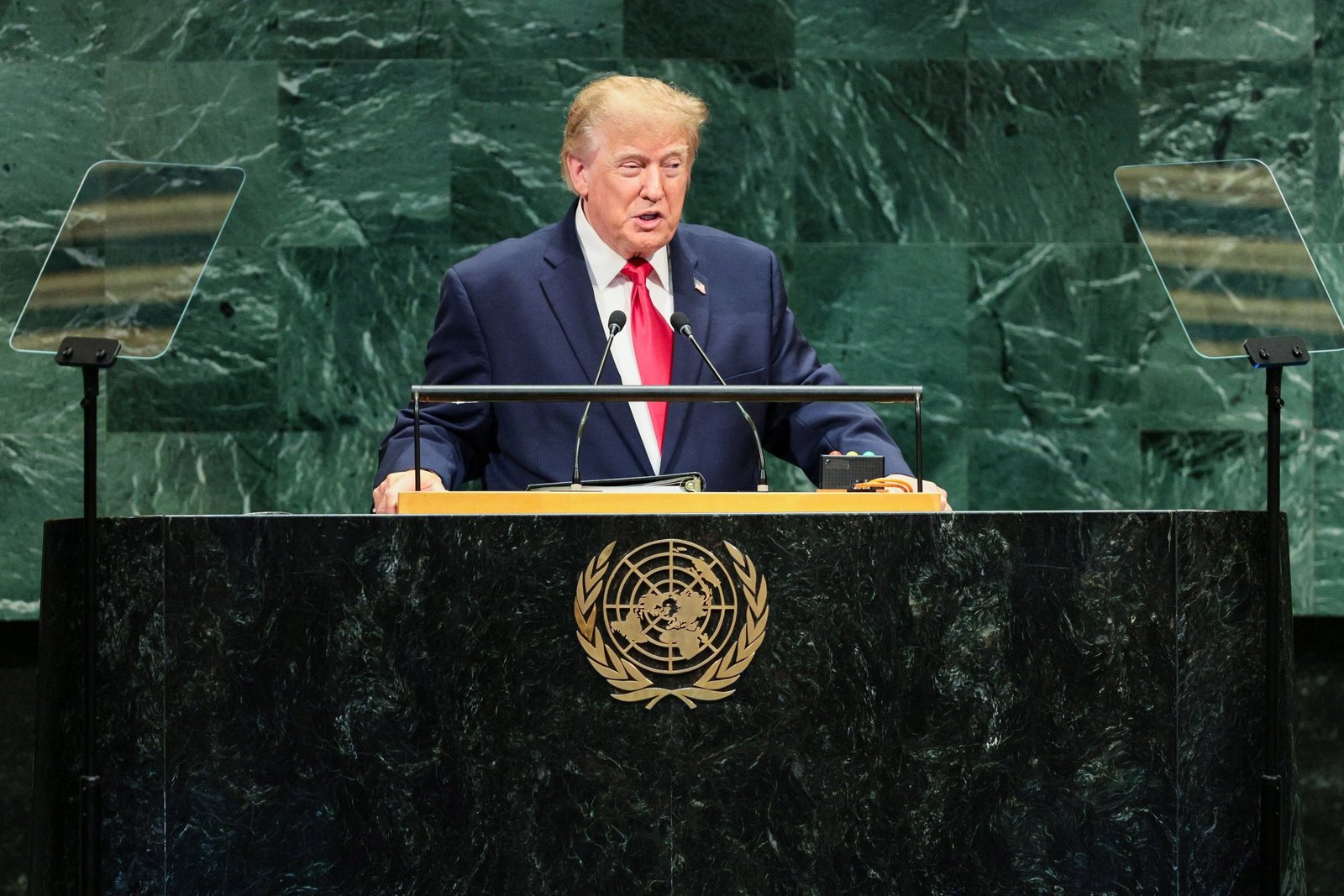
President Donald Trump told the United Nations General Assembly on Tuesday that the United States would formally rename artificial intelligence as “super intelligence” across all government documents, arguing that the word “artificial” makes the technology sound fake when, in his view, it is anything but. Speaking to the global body, Trump said the change would apply immediately to U.S. government communications and expressed hope that the rest of the world would eventually follow the same naming convention, though he acknowledged skepticism that other countries would actually adopt it.
Trump framed the semantic shift as part of a broader argument against international efforts to regulate AI development. He told the assembly the United States totally rejects any attempt to construct what he called a globalist scheme to control the technology, and said he had no intention of stifling the growth of something he described as potentially bigger than the Industrial Revolution. He added that the U.S. would only encourage what he now insists on calling super intelligence, framing rapid, largely unregulated development as the correct national strategy rather than a risk requiring international coordination.
The renaming effort did not come entirely out of nowhere. According to Axios, Trump had recently solicited input from his own supporters on the question, posting multiple polls on Truth Social asking how the technology should be rebranded, with “superior intelligence” reportedly winning at least one of those informal polls before Trump ultimately settled on “super intelligence” for his UN announcement. He had also separately called for establishing a new government body referred to as an “AI Force,” part of a broader push that has included searching for a Silicon Valley figure to serve as the administration’s next AI czar.
The timing of Trump’s announcement is notable given how loudly AI safety concerns have been circulating through Washington and the broader tech industry in recent weeks. His remarks came just days after a former Anthropic researcher, Jacob Coxon, resigned publicly and warned that people building frontier AI systems privately believe the technology could pose an existential threat to humanity within the decade, a claim that ignited significant public debate and drew responses from figures across the AI industry, including current Anthropic researcher Evan Hubinger, who separately estimated a meaningful probability of catastrophic AI outcomes within ten years.
Trump directly dismissed those kinds of warnings during his UN speech, comparing them to what he characterized as previous unfounded doomsday predictions. He drew a parallel to earlier warnings about climate change, arguing that predictions from decades ago claiming humanity would face catastrophe within a set timeframe had not come true, and suggested the same people making those earlier claims were now the ones warning that AI would prove similarly destructive. He described concerns about AI existential risk in the same breath as what he called other politically motivated hoaxes, a framing consistent with skepticism he has expressed publicly on multiple occasions in recent weeks about the wave of AI safety warnings coming from researchers at major labs.
Notably, the technical term “super intelligence,” or artificial superintelligence, already carries a specific and well-established meaning within the AI research community that runs somewhat at odds with how Trump used it in his speech. Superintelligence typically refers to a hypothetical form of AI that would exceed human intelligence across virtually every domain, a milestone widely regarded as both the ultimate technical goal pursued by leading frontier AI labs and, simultaneously, the single greatest source of concern among researchers warning about AI’s potential threat to humanity. Applying that specific, high-stakes technical term as a blanket replacement for the broader, more general category of “artificial intelligence” struck some observers as a confusing choice given the term’s existing and fairly precise meaning within the field.
Reaction to the rebranding effort was mixed even among Trump’s own political base. Far-right commentator Matt Walsh posted on X that he was already anticipating conservatives dutifully adopting the new terminology simply because Trump had instructed them to, separately describing the renaming push as bizarrely dystopian and calling it an odd priority to focus on given other pressing economic concerns, including rising fuel prices. National average gas prices had climbed to roughly $4.47 per gallon at the time of Trump’s speech, up substantially from around $2.98 before the administration’s conflict with Iran began, a contrast that fed into criticism that the AI renaming effort seemed disconnected from more pressing issues facing American consumers.
The announcement also arrived at a significant moment in U.S.-China relations specifically. According to Yahoo News, China and the United States are currently discussing establishing a formal communication channel focused on AI-related concerns, part of the broader lead-up to a planned Washington summit between Trump and Chinese President Xi Jinping this week. AI is expected to feature prominently in those talks, making Trump’s public rejection of international AI regulation frameworks, delivered just days before that summit, a notable signal of the administration’s negotiating posture heading into direct discussions with Beijing over how the two countries might coordinate, or decline to coordinate, on AI safety and development going forward.
Whether the renaming effort has any lasting practical effect on how U.S. government agencies formally refer to the technology remains to be seen, and it is unclear whether federal agencies have received any formal directive translating Trump’s UN remarks into an actual implemented policy change across government documentation. What is clearer is that the announcement fits into a broader pattern from the administration of downplaying AI existential risk concerns while simultaneously pushing to accelerate the pace of American AI development, a stance that puts Trump at direct odds with the growing chorus of researchers, including some inside the very labs building frontier AI systems, who have spent recent weeks publicly warning that the technology’s risks deserve considerably more caution than the administration’s current posture reflects. Continuing coverage of how AI policy debates are unfolding at the highest levels of government is available on Business Tech. Additional detail on Trump’s UN remarks is available through Axios’s coverage of the speech, and further reporting on the broader AI safety debate can be found through The Hill’s coverage of the story.