|
Getting your Trinity Audio player ready...
|
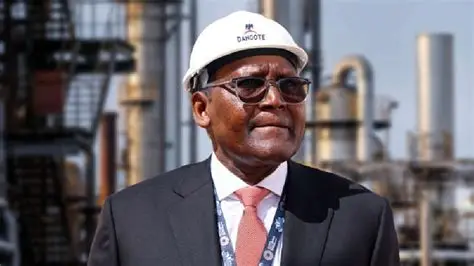
Aliko Dangote, Africa’s richest man, spent this week pursuing two enormous and interconnected projects simultaneously: selling shares in his Nigerian refinery to an unprecedented number of retail investors, and physically breaking ground on a second mega-refinery in Kenya that would extend his energy empire across all of East Africa. Together, the two moves represent one of the most ambitious expansions of private industrial capital ever attempted on the continent, and they come with financial and political stakes that extend well beyond Dangote’s own fortune.
The IPO at the center of this push is for Dangote Petroleum Refinery and Petrochemicals FZE, which is offering 4.1 billion shares priced at 525 naira each in what’s being marketed as Africa’s largest-ever initial public offering. The company is seeking roughly 2.15 trillion naira, about $1.6 billion, with the option to raise as much as $2.1 billion if demand allows. What makes the offering genuinely unusual isn’t the size of the capital raise itself, it’s who Dangote is trying to sell it to. He’s targeting 10 million individual investors, a figure that would represent nearly four times the 2.7 million people currently active in Nigeria’s entire stock market, according to Jude Chiemeka, chief executive of the Nigerian Exchange. Dangote has deliberately pitched the offering as an “IPO for the people,” setting the minimum purchase at just 10 shares, roughly $4, specifically to make participation accessible to ordinary Nigerians who’ve never owned stock before rather than confining the raise to institutional investors and the country’s existing, relatively small investor class.
Dangote has described investor demand for the offer as “enormous,” though he stopped short of providing specific subscription figures when speaking to reporters in Nairobi on Tuesday. The subscription window closes October 13, and the deal carries a $400 million underwriting commitment from Dangote’s lead financial advisers, giving the offering a baseline of guaranteed capital even if retail participation falls short of the ambitious 10 million target. Proceeds are earmarked specifically to double the Lagos refinery’s processing capacity to 1.4 million barrels per day by the first quarter of 2029, a scale-up that would meaningfully expand the plant’s existing output and further cement its position as Africa’s largest refinery.
The IPO’s reach is also extending beyond Nigeria’s own borders through a series of regional partnerships Dangote has been striking in recent days. Botswana is exploring a mechanism allowing its own investors to buy into the Nigerian refinery through depositary receipts listed on the Gaborone exchange, while Kenyan investors are being offered a similar pathway, with underlying shares held in custody in Nigeria and depositary receipts made available locally. Kenya’s Capital Markets Authority issued a formal warning to investors earlier in September regarding that cross-border structure, a caution worth noting given how novel this kind of pan-African retail investment mechanism remains.
On the same trip to Kenya, Dangote formally broke ground Wednesday on the East African refinery, telling attendees at the ceremony that the project marked, in his words, a new chapter in Africa’s industrial journey. The Lamu County facility, located at a deep seaport Dangote chose specifically for its port depth and stable ground conditions after initially considering Tanzania as an alternative site, carries an estimated construction cost between $15 billion and $16 billion and a planned capacity of 700,000 barrels per day, a scale that would make it larger than any refinery currently operating in Europe. Kenyan President William Ruto has said the project could create as many as 60,000 jobs, and the refinery is designed to serve not just Kenya but neighboring markets including Uganda, Tanzania, Rwanda, Burundi, South Sudan, Ethiopia, and the Democratic Republic of Congo, a region that remains heavily dependent on imported refined petroleum products despite substantial crude reserves scattered across several nearby countries.
That regional dependency is precisely the dynamic Dangote has framed his broader Africa strategy around. Speaking about the continent’s longstanding pattern of exporting raw crude oil while importing finished refined products, he argued the new Kenya facility would help reverse exactly that imbalance for East Africa, much as his Lagos refinery has already begun doing for West Africa since starting operations less than three years ago. Most of the crude feeding the Kenyan refinery will initially need to arrive by ship from other regions, with Dangote confirming sourcing plans from the Middle East, the United States, and elsewhere, though he’s said the facility would pivot toward regional supply as countries like Kenya and Mozambique ramp up their own domestic oil production over time.
To help secure Kenyan public buy-in for the project, Dangote has pledged the East African refinery will list separately on the Nairobi Securities Exchange once operational, telling an investor audience in the capital that he was making a firm commitment to that listing. Kenya has also been offered a direct equity stake in the project itself, with East African countries collectively being offered a combined 30 percent share of the refinery, and Kenya specifically able to take up to 10 percent, worth roughly $500 million, according to David Ndii, economic adviser to President Ruto. For Honeywell Technologies, the US-based engineering firm Dangote selected to help design and equip the facility, the project carries a reported $300 million contract, with the company reusing engineering designs from Dangote’s existing Lekki refinery specifically to compress the Kenya project’s construction timeline by close to two years.
Not everything has gone smoothly on the Kenya side. A Kenyan court reportedly paused work on the $16 billion project at one point following a legal petition, a development that adds genuine uncertainty to Dangote’s stated goal of completing the Lamu facility by 2030, even as groundbreaking proceeded this week despite that earlier legal challenge. Whether both the Nigerian IPO and the Kenyan refinery ultimately deliver on their respective ambitions, 10 million first-time African retail investors and a second mega-refinery reshaping East Africa’s fuel supply chain, will likely become clearer over the coming years as construction progresses in Lamu and as the October 13 subscription deadline reveals just how many ordinary Nigerians actually answered Dangote’s call to buy in.