|
Getting your Trinity Audio player ready...
|
Honor Magic 9 Series Hands-On: A Futuristic Design Built Around a Cinema-Grade Camera
Honor has finally pulled back the curtain on the design of its next flagship lineup, and the Magic 9 series looks like a phone built by people who spent more time thinking about photography than almost anything else. The company officially confirmed the design, camera specs, and a September 28 launch date in Beijing, giving the public its clearest look yet at what may be one of the most camera-ambitious Android phones to arrive this year.
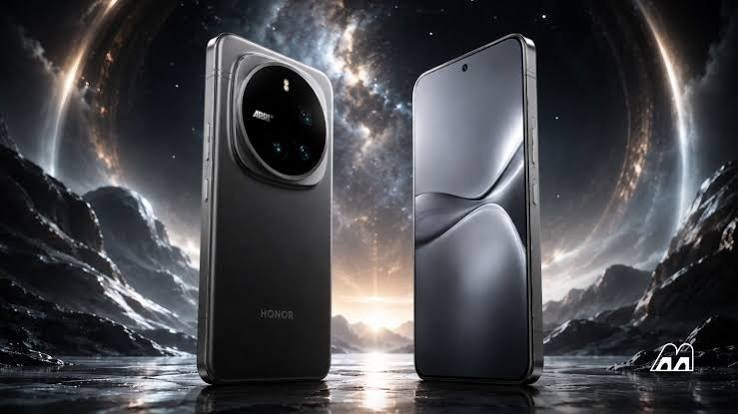
The first thing that stands out about the Magic 9’s design is the rear camera module, and it’s impossible to miss. Rather than the smaller, tucked-away camera bumps that have become standard on most flagship phones, Honor has gone with a large, rounded rectangular module dominating the upper section of the back panel. Inside that module sit three distinct cutouts, with the largest housing the telephoto camera, an LED flash, and branding from ARRI, the legendary German cinema camera manufacturer Honor partnered with earlier this year. Two additional circular sections sit to the right, rounding out the camera array. On the front, a pill-shaped cutout houses the selfie camera alongside a 3D time-of-flight sensor, a combination more commonly associated with advanced facial recognition and depth-sensing than typical flagship selfie setups.
Honor is also introducing a new Moss Green colorway alongside the design reveal, a muted, earthy tone that leans away from the glossy, mirror-finish aesthetics many flagship phones have leaned into over the past few years. Combined with the metal frame and refined antenna layout visible in official renders, the overall look feels distinctly cinematic rather than purely tech-forward, which tracks given how central the ARRI partnership is to this entire generation of devices.
That camera partnership is really the headline story here. ARRI is the company behind cinema cameras used across major Hollywood productions, and its involvement with Honor goes well beyond a co-branding exercise. The Magic 9 series is expected to bring ARRI’s actual color science technology to a smartphone for the first time, including ARRI LogC3 color profiles, the ARRI Look image processing style, and a dedicated ARRI cinema shooting mode. For anyone who’s spent time comparing footage shot on professional cinema cameras versus a typical smartphone, the promise here is that Honor is trying to bring some of that same tonal depth and color accuracy down to a device that fits in your pocket.
On paper, the hardware backing that ambition is genuinely impressive. Leaked and partially confirmed specs point to dual 200-megapixel rear cameras, a configuration few competitors have matched. The main sensor reportedly measures 1/1.28 inches, among the largest sensors ever fitted into a smartphone, paired with an f/1.57 aperture and 3-degree optical image stabilization, a combination designed to maximize light capture in low-light conditions. The telephoto camera uses a slightly smaller 1/1.4-inch sensor at f/2.6 aperture, also at 200 megapixels, which is a notable departure from how most flagships handle zoom photography. Samsung’s Galaxy S25 Ultra, for comparison, pairs its 200-megapixel main sensor with a much lower-resolution 50-megapixel telephoto lens. Matching 200 megapixels across both the main and telephoto cameras gives Honor a real hardware edge for anyone who shoots a lot of zoomed-in photography, since there’s simply more image data available to work with when cropping or processing shots after capture. Honor is also reportedly introducing a new 500mm teleconverter option alongside its existing 200mm teleconverter, extending the phone’s optical reach even further for telephoto shooting.
Beyond the cameras, the Magic 9 series is expected to be built around one of the most advanced mobile chipsets available this year. Reports point to Qualcomm’s next-generation 2nm Snapdragon processor, which would make Honor among the first companies to ship a flagship phone built on that manufacturing node. A more efficient, higher-performance chip like that matters for a camera-heavy phone in particular, since processing 200-megapixel images from dual sensors, especially with the added computational load of ARRI’s color science tools, demands serious on-device processing power. Battery capacity is also expected to be generous, with some reports suggesting a battery above 8,000mAh, a substantial jump that should help offset the power demands of both the high-resolution cameras and the larger, more power-hungry display options.
Display-wise, the series is expected to offer two screen sizes, roughly 6.36 inches for smaller models and 6.85 inches for the largest variant, both built around a 2.5D flat screen design rather than the heavily curved edges Honor’s earlier Magic phones favored. That shift toward flatter displays mirrors a broader trend across the Android flagship space, where manufacturers have increasingly moved away from aggressively curved edges after years of user complaints about accidental touches and screen distortion near the sides.
The lineup itself is expected to include at least three models, a standard Magic 9, a Magic 9 Pro, and a Magic 9 Pro Max, giving buyers a range of price points and specifications to choose from depending on how much of that camera and display technology they actually want to pay for. Honor has also teased that the Magic 9 series will debut what it’s calling an Agentic OS, suggesting the software side of this launch will lean heavily into AI-driven features that go beyond simple assistant functions, potentially allowing the phone’s software to handle more complex, multi-step tasks autonomously.
Taken together, the Magic 9 series looks like Honor’s most deliberate attempt yet to differentiate itself in an incredibly crowded flagship Android market, not through incremental spec bumps but through a genuinely distinctive camera identity built around a real partnership with one of the most respected names in cinema technology. Whether the ARRI collaboration translates into photos and videos that actually look meaningfully different from what other 200-megapixel camera systems already produce remains the real question, and one that won’t be fully answerable until review units start landing in people’s hands after the September 28 launch. But based on the design and specs revealed so far, Honor is clearly betting that photography, not just raw performance numbers, is what will set the Magic 9 apart.