|
Getting your Trinity Audio player ready...
|
Pastor and author Charles R. Swindoll has spent decades teaching a simple idea: “Life is 10% what happens to you and 90% how you react to it.” Variations of the phrase existed in print before Swindoll became associated with it, but he is the one who built it into a lasting personal message, repeating it across his books and sermons for over thirty years, until it eventually became the title of his own bestselling 2023 book. By his publisher’s account, the line has been shared more than sixty-five million times worldwide.
The reason it has spread that widely is not because the numbers are scientifically precise. Nobody is actually measuring reaction against circumstance down to the percentage point. The reason it works is that it names something people already suspect but rarely organise into a clear rule, that the event itself often matters far less than what a person does with it afterward.
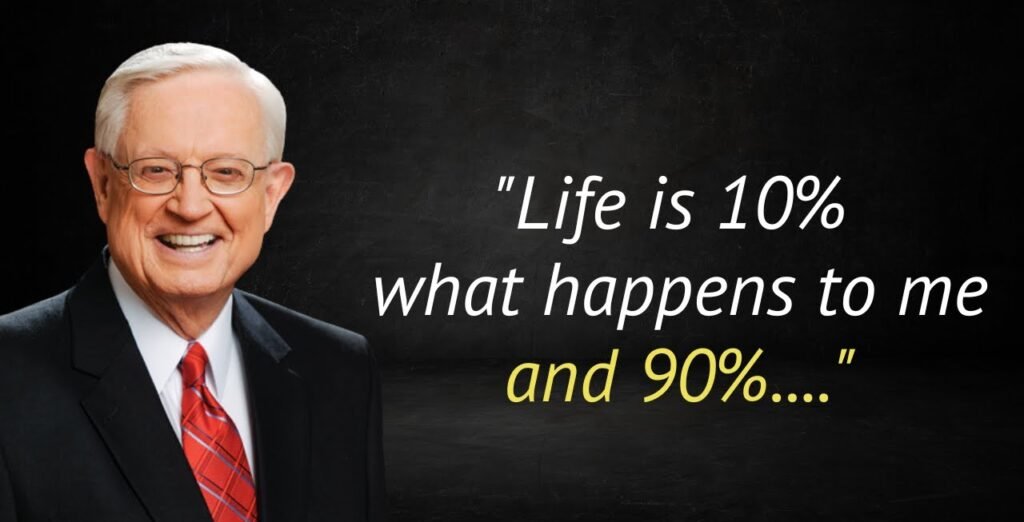
It is tempting to read this quote as saying that circumstances barely matter, which is not quite fair to how much genuine hardship exists in the world. A fairer reading is that Swindoll is drawing a line between two things that are often confused, the part of a situation a person cannot control and the part they still fully control regardless. These are not in competition. A person can fully acknowledge that a circumstance is genuinely difficult while still recognising that their response to it remains entirely their own.
Consider two small business owners who both lose their biggest client in the same month. One spends weeks replaying the loss, blaming the client, blaming the market, and delaying any new outreach. The other spends a difficult week processing the same loss, then starts contacting new prospects the following Monday. The circumstance was identical. The 90% Swindoll is describing is the only part that actually diverged.
A useful exercise inside this idea is separating the original event from everything a person adds to it afterward. Losing a client is the 10%. The weeks of rumination, the assumptions about what it means for the future, and the delay in taking the next action often belong to the 90%, even though they can feel like part of the original problem. Being honest about where that line actually sits is often the first step toward changing the response.
Build the habit of choosing a response instead of defaulting to one
Reactions can feel automatic, but Swindoll’s framing treats them as a choice made repeatedly rather than a fixed personality trait. A habit of pausing before responding, even briefly, tends to move a reaction from something purely automatic toward something closer to a decision. This is a skill that improves with deliberate practice in smaller situations, long before it is tested by a genuinely difficult one.
The quote is sometimes flattened into a demand for constant positivity, which misses the point. Swindoll’s own writing is explicit that he is not promising endless good feeling. Acknowledging that a situation is genuinely hard is compatible with still choosing a constructive response to it. The 90% is about the response, not about denying that the 10% was real.
This does not require ignoring genuine setbacks or forcing false optimism. It can start with a simple pause before reacting to bad news, whether that is a lost deal, a harsh piece of feedback, or an unexpected delay. At work, this might mean separating the facts of a setback from the story being told about it, and choosing the next action deliberately rather than automatically. In personal life, it can mean noticing when a difficult event has been over-extended by weeks of replaying it, and choosing at some point to redirect that energy toward a response instead. None of this erases the original difficulty. It simply keeps the far larger 90% from being handed over by default.
Why this advice still holds true today
Circumstances outside anyone’s control are not going away, and Swindoll never claimed they would. What he kept returning to across decades of teaching is the much narrower and more useful question of what remains inside a person’s control once the circumstance has already happened. That question has not changed shape since 1974, when an early version of this idea first appeared in print, and it has not changed shape since Swindoll made it his own. The event will always be a small fraction of the story. What a person does next is still, by his account, the far larger part.