|
Getting your Trinity Audio player ready...
|
₦525 for a ₦65 Trillion Company: What Dangote Refinery Has to Earn Before Today’s Buyers Get Paid
The largest share sale in African history opened this morning. The interesting question is not whether Dangote Refinery is an extraordinary industrial asset. It plainly is. The question is what price an extraordinary asset is worth, and what the future would have to look like for someone buying at ₦525 to be glad they did.
The Dangote Refinery IPO opened this month at ₦525 per share, and within an hour of trading, Nigerian investors had already committed close to ₦1.5 trillion, a response that says more about appetite than about price. That distinction matters, because the real question behind the Dangote Refinery IPO is not whether Nigerians want to own a piece of the largest single-train refinery in the world. It is whether ₦525 per share, and the roughly ₦65 trillion valuation it implies, is actually a good price to pay for that ownership. This analysis sets the excitement aside and asks the harder question directly: what would Dangote Refinery need to earn, year after year, for today’s buyers in the Dangote Refinery IPO to look back and feel they paid a fair price, rather than a full one. To answer that, we examine the valuation, the recent swing to ₦2.5 trillion in profit, the $5.7 billion debt, the $14 billion expansion, and the currency risk every diaspora investor should weigh before deciding whether the Dangote Refinery IPO deserves a place in their portfolio.
What This Analysis Will Examine
Before forming a view on the Dangote Refinery IPO, the BusinessTech Nigeria research team set out to examine the offer from several distinct angles, rather than judge it by the ₦525 headline price alone. This is the scope of what follows:
- Nineteen years of watching one Dangote company — what the Dangote Sugar listing of 2007 teaches about holding a Dangote business for the long term, and where that lesson does and does not apply here.
- The business versus the investment — why owning a genuinely excellent company does not automatically mean that buying its shares at any given price is a good investment.
- The scale of the refinery — what 700,000 barrels per day actually means in practice, what the planned expansion adds, and how large the business could realistically become over the next decade.
- What ₦525 really tells you — why a share price on its own says almost nothing until it is set against the company’s total valuation, its share count, its earnings, and its cash flow.
- The ₦65 trillion question — the number that actually matters behind the offer, and whether today’s price already assumes years of future success that has not yet happened.
- Reading the recent numbers properly — the swing from losses to roughly ₦2.5 trillion in half-year profit, what drove it, and why a move this fast deserves scrutiny as much as admiration.
- The $14.3 billion expansion, examined as a decision — what the expansion could add to the business, how it is being financed, and who ultimately carries the risk if it does not go to plan.
- The $5.7 billion debt, properly unpacked — whether it is a warning sign, a reasonable tool for building an asset of this scale, or somewhere in between, and what would change that answer.
- The bull case — what would genuinely have to go right for today’s valuation to look cheap in five or ten years’ time.
- Where this analysis could be wrong — the specific assumptions that could fail, and the risks that could make this investment considerably less attractive than it currently appears.
- The currency question for diaspora investors — how the naira-to-dollar exchange rate can turn a winning naira investment into a losing one, once it is converted home.
- A personal approach to risk — practical ways to protect capital and peace of mind from the possibility that a great business still turns out to be a disappointing investment.
- Five questions before buying any IPO — the questions this team believes every investor should be able to answer, for this offer and for the next one, before committing any money.
At nine o’clock this morning, Monday 14 September 2026, Nigerians began applying for shares in Dangote Petroleum Refinery and Petrochemicals FZE. The offer is 4.1 billion ordinary shares at ₦525 each, closing on 13 October, with a listing on the Nigerian Exchange expected in November. The company is targeting as many as 10 million retail investors, and the minimum application is 10 shares, or ₦5,250.
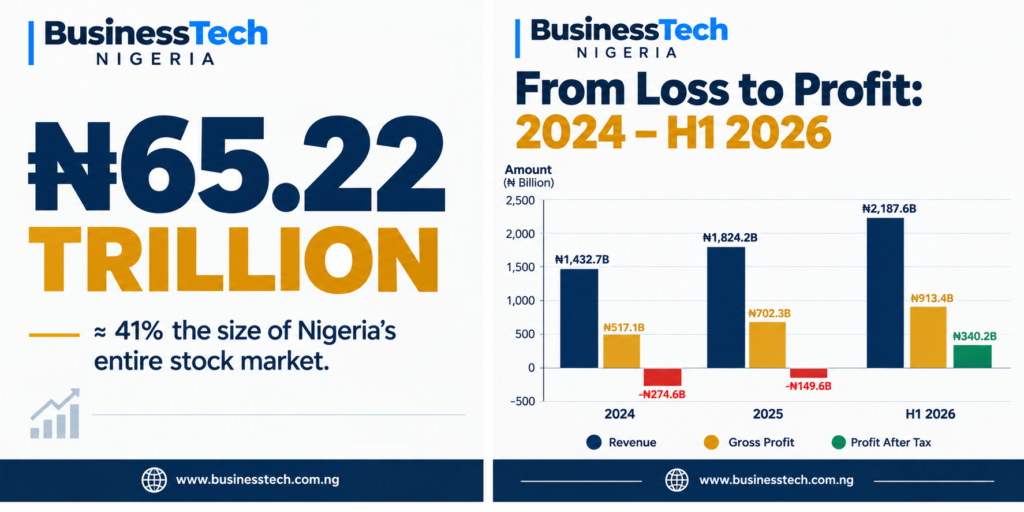
Almost every headline you have read since the signing ceremony at Eko Hotels last week has framed this as history. It is. Nigeria’s entire equity market was worth about ₦157.59 trillion on 11 September. Admitting the refinery at ₦65.22 trillion would add roughly 41 per cent to that in a single listing. No African company has ever raised this much from the public.
But history and investment return are different things, and the distinction is the entire subject of this article.
There is a temptation, particularly strong in Nigeria right now, to treat the two as one. The refinery is a genuine national achievement. It has changed the country’s import bill. It has changed the balance of payments. It has, for the first time in two generations, made it plausible that Nigeria refines what Nigeria drills. A reader could be forgiven for concluding that anything so important must also be a good thing to own at any price.
That conclusion does not follow, and no amount of national pride makes it follow.
An investment is a claim on future cash. When you pay ₦525 for a share of this business, you are not buying the ten years of construction, the 400-hectare site at Ibeju-Lekki, the jetties, the self-generated power, or the fact that the plant exists at all. All of that is already built, already paid for, and already reflected in the price you are being asked to pay. You are buying the cash the refinery will generate from here, discounted back, divided by 124.23 billion shares, net of the debt ahead of you in the queue.
So the question this article sets out to answer is narrow and uncomfortable:
At ₦525 per share and roughly ₦65 trillion of implied equity value, what earnings, cash flows and durable advantages would Dangote Refinery have to deliver for a buyer today to earn a decent long-term return?
Not whether the refinery is good for Nigeria. It is. Not whether Aliko Dangote built something remarkable. He did. Not whether the shares will pop on the first day of trading in November. Nobody knows, and first-day price movements tell you nothing about a ten-year holding.
Over the sections that follow we will take apart the valuation, the balance sheet, the $14.3 billion expansion programme, the refining margin that produced this year’s spectacular numbers, and the currency arithmetic that decides what a Nigerian in Houston or Manchester actually earns on a naira-denominated asset. We will build bull, base and bear cases, and we will be explicit about which figures come from the prospectus, which come from analysts with a commercial relationship to the offer, and which are our own clearly labelled assumptions.
You may finish this article and decide to subscribe. You may finish it and decide not to. Either is a reasonable outcome. What should not happen is that you subscribe because ₦5,250 felt small, or because everyone at your office is applying, or because a company this large obviously cannot disappoint you.
Companies this large disappoint investors all the time. Usually because the investors paid too much.
Nineteen Years Ago, Dangote Sugar Listed at ₦18
To understand why price matters more than prestige, it helps to look at the last time Nigerians were offered a piece of a Dangote industrial asset and told it would change their lives.
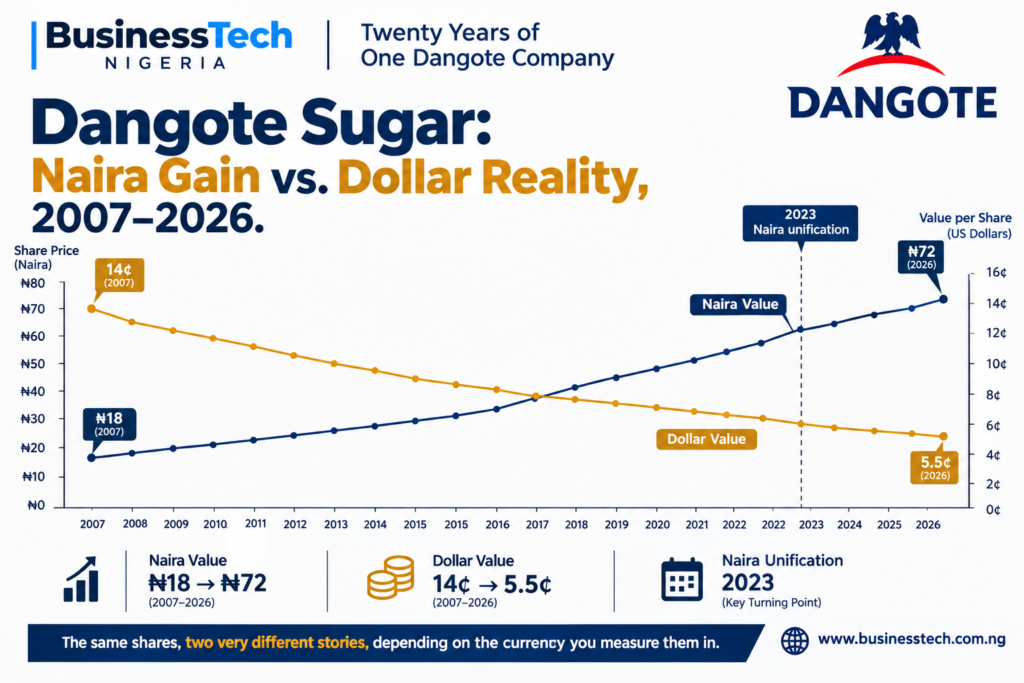
Dangote Sugar Refinery listed on the Nigerian Stock Exchange on 8 March 2007 at ₦18 per share, following the divestment of a 25 per cent holding by Dangote Industries. It was named Best African Initial Public Offer for 2007 by the Africa Investor index series, and won the Exchange’s President’s Merit Award for the best quoted company in food and beverages that same year. If you were an adult with savings in 2007, you remember the mood. It was not scepticism.
So what happened to the person who bought at ₦18 and never sold?
Dangote Sugar traded at ₦72.00 on the Nigerian Exchange on 6 September 2026. Four times the listing price, over nineteen and a half years. Compounded, that is a share price gain of roughly 7 per cent a year before dividends. Add the dividends the company paid across that period and the naira return improves, though not dramatically: the 2022 dividend, for example, was ₦1.50 per share, a total payout of ₦18.22 billion, and that ₦1.50 remains the most recent dividend on record, with an ex-dividend date in March 2023. The payout stopped because the earnings stopped. Dangote Sugar reported a loss of ₦64.06 billion in 2025 on revenue of ₦829.21 billion, which was itself an improvement on a considerably larger loss in 2024.
Seven per cent a year, in naira, from a company that was and is a national brand with a dominant market position and the same chairman.
Now do the calculation in dollars, because this is where the lesson turns sharp. In March 2007 the naira traded at roughly ₦125 to ₦130 to the US dollar at the official rate. A ₦18 share cost about fourteen US cents. Today, at ₦72 and the ₦1,319.54 reference rate used in the refinery’s own prospectus, that same share is worth about five and a half US cents.
In naira, the investor quadrupled their money. In dollars, they lost around three-fifths of it.
Both statements are true. They describe the same shares on the same days. This is not a criticism of Dangote Sugar, whose managers do not set Nigeria’s monetary policy, and it is not a prediction about Dangote Refinery, whose economics are completely different. It is a demonstration of three things that will recur throughout this analysis.
First, a strong business and a strong investment return are separable outcomes. Dangote Sugar remained the leading sugar refiner in Nigeria throughout. That was never the variable that failed.
Second, the currency in which you measure return is a decision, not a detail. We will return to this at length in the diaspora section, because a large share of the demand for this IPO is coming from Nigerians who earn and spend in dollars, pounds and Canadian dollars.
Third, the price you pay at entry sets the ceiling on what the business can do for you. Dangote Sugar listed into an enthusiastic market at a valuation that already assumed a great deal of success. When the success arrived, much of it had already been paid for.
That last point is the one worth carrying into every remaining section. It is also the reason we are going to spend far more time on ₦65 trillion than on ₦525.
One further caution about this comparison, which matters for intellectual honesty. Dangote Sugar is a naira-revenue business importing a dollar-priced raw material, which is close to the worst possible currency structure for a Nigerian company. The refinery is close to the opposite: it sells a large volume of its output in dollars into export markets. Sugar’s history does not forecast the refinery’s future. It only teaches you which questions to ask.
The Business and the Investment Are Not the Same Thing
Hold two sentences in your head at the same time.
Dangote Refinery is one of the most impressive industrial businesses ever built in Africa.
Dangote Refinery at ₦525 per share may or may not be a good investment.
Neither sentence contradicts the other. Getting comfortable with that is most of what separates a durable investor from an enthusiastic one.
Start with the first sentence, because the evidence for it is strong and recent. For the six months to 30 June 2026 the company reported revenue of ₦19.13 trillion, about $13.9 billion, gross profit of ₦3.43 trillion and profit after tax of ₦2.50 trillion. That compares with the year to 31 December 2025, when revenue was ₦18.73 trillion but the company recorded a loss after tax of ₦723 billion on commissioning and ramp-up costs. Losses across the first two years of commercial operation came to roughly $1.99 billion, about $1.51 billion in 2024 and $475.8 million in 2025. Six months of 2026 did not merely reverse a bad year. They reversed the entire construction-phase loss history.
Total assets stood at ₦29.07 trillion at June 2026, with net debt to EBITDA of 0.27 times. Net cash from operating activities in the first half was ₦1.751 trillion. These are not the numbers of a fragile company. They are the numbers of a large industrial asset that has crossed from construction risk into operating risk and is now generating serious cash.
Now the second sentence. What are you being asked to pay for that?
At ₦525, with 120.13 billion existing shares registered and 4.1 billion on offer, the implied equity value is about ₦65.2 trillion, or roughly $47 billion, and the free float represents about 3.41 per cent of the company. Aliko Dangote holds 92.3 per cent of the refinery before the offer, diluting to roughly 89.25 per cent once the new shares are issued.
That ₦65 trillion is the number that decides your return. Not ₦525.
Here is the arithmetic that frames everything to come. Annualising the first-half profit of $1.82 billion gives roughly $3.64 billion for the full year, which puts the company at about 13 times earnings at a $47 billion valuation. At $3 billion of annual profit the multiple rises to about 15.7 times, at $2.5 billion to 18.8 times, and lower still if earnings normalise further.
Thirteen times earnings for a growing industrial monopoly is not obviously expensive. Nineteen times, for a cyclical refiner in a frontier currency, is a different proposition. The gap between those two outcomes is not a matter of opinion about Dangote. It is a matter of whether the first half of 2026 was a normal six months or an unusually good one.
There is strong reason to think it was unusually good. The gross refining margin was $24.50 per barrel in the first half of 2026, against $13.70 per barrel in 2025 and $10.70 per barrel in 2024. The first-quarter figure of $33.70 per barrel was partly inflated by supply disruption linked to the Iran conflict and had already normalised to the $24.50 half-year average, with Renaissance Capital forecasting $27.55 per barrel for the full year. Refining margins are the single most volatile input in this business. They are set in global markets, not in Lekki, and they mean-revert.
This is why the analysts who have published on the offer do not agree with each other. CardinalStone places a 12-month equity valuation of ₦77.7 trillion on the refinery, a target price of ₦688.09, while Chapel Hill Denham estimates a current fair equity value of $62.53 billion, equivalent to ₦82.62 trillion. Both are above the ₦65.22 trillion indicative listing valuation in the prospectus. Read those numbers with the relationship in mind: CardinalStone is also one of the joint issuing houses on the IPO, though its report states that the analysts’ views are independently determined. That does not make the work wrong. It does mean it is not disinterested, and a serious investor weights research accordingly.
So we arrive at the structure of the whole analysis. The refinery’s quality is largely established. Its price is the open question. And between those two sits a set of variables that will determine whether ₦525 was cheap, fair or dear: how much crude it can secure and at what cost, what refining margins do over a full cycle, whether $14.3 billion of expansion capital earns more than it costs, how the free zone tax position evolves after 2027, what the naira does, and how much of the cash generated ever reaches a minority shareholder holding 3 per cent of a company controlled by one man.
We will take each in turn.
Before we do, one piece of housekeeping on figures, because you will encounter conflicting numbers everywhere this month. THISDAY reported first-half revenue of about ₦19.47 trillion and profit after tax of roughly ₦2.55 trillion, using a conversion rate of ₦1,400 to the dollar, while the prospectus summary gives ₦19.13 trillion and ₦2.50 trillion. Both describe the same dollar results. The difference is the exchange rate applied, and it is worth roughly ₦50 billion of apparent profit. The company reports in US dollars. When you see naira figures, always ask at what rate.
Figures not independently verified and labelled as such in the text: the March 2007 naira/dollar official rate is given as an approximate range of ₦125 to ₦130 based on the period’s official rate rather than a single confirmed daily fixing, and the dollar-return calculation on Dangote Sugar is our own arithmetic from that approximation. The 2007 to 2026 Dangote Sugar total return including all dividends has not been reconstructed from a full dividend history and is described qualitatively rather than as a precise number.
The Scale: 700,000 Barrels and Plans to Double
Before we argue about price, we should be precise about what is actually being sold, because the physical facts of this asset are the foundation of every scenario later in this article.
The refinery at Ibeju-Lekki was designed as a 650,000 barrels per day single-train facility. It reached that original nameplate capacity during testing in February 2026 and subsequently processed as much as 700,000 barrels per day in June, the increase delivered by de-bottlenecking the existing crude distillation unit, a programme that took roughly two and a half years. Average utilisation across the first half of 2026 was 83.6 per cent.
That last number deserves more attention than it usually gets. Average utilisation of 83.6 per cent means the plant was not running flat out for the whole period in which it earned ₦2.50 trillion. There is headroom. Marathon Petroleum, by comparison, achieved 94 per cent crude capacity utilisation in its second quarter of 2026. Closing that gap is real, achievable earnings growth that requires no new steel and no new capital. It is one of the strongest arguments the bulls have.
The output is now material in global terms, not just African ones. In June the refinery overtook the United States as the largest external supplier of jet fuel to Europe, and held that position in July. Imports of clean products into West Africa from outside the region fell by almost 25 per cent year-on-year in the second quarter. A plant that was a domestic import-substitution project three years ago is now a swing supplier to the Atlantic basin.
Then there is the expansion. A second crude distillation unit began construction in January 2026, intended to add roughly another 700,000 barrels per day and take the complex to about 1.4 million barrels per day. Company statements have put mechanical completion around late 2028, with the prospectus framing the doubling as a 2030 objective, and Aliko Dangote saying at the signing ceremony that he hopes the plant becomes the world’s largest single-train refinery by 2028. We will treat the 2028 to 2030 window as the honest range rather than pretending a single date is confirmed. The total programme is estimated at $14.3 billion, and the prospectus schedules capital expenditure of $4.8 billion for the remainder of 2026, $3.9 billion in 2027 and $3.1 billion in 2028.
Now the constraint that decides whether any of this converts into profit.
A refinery does not make money from capacity. It makes money from throughput, and throughput requires crude. The prospectus discloses access to volumes of up to 350,000 barrels per day under the Domestic Crude Supply Obligation framework, though it states these volumes are subject to availability, with the balance sourced from the international spot market and from supply arrangements with international counterparties. As at 30 June 2026 the refinery had processed 36 different crude grades from Africa, South America, the United States and the Middle East. The company itself cautions that multiple supply arrangements do not guarantee uninterrupted supply.
Read that again, because it is the single most important operational sentence in the prospectus. The Domestic Crude Supply Obligation covers, at best, half of current capacity and is explicitly conditional. Nigerian crude receipts peaked near 650,000 barrels per day in May 2026 before easing to 575,000 in June. WTI Midland from the US Gulf Coast has become a structural part of the diet rather than an emergency supplement, and for October the refinery secured at least 16 million barrels of Nigerian crude, roughly 520,000 barrels per day, alongside imported WTI cargoes.
So the strategic picture at 700,000 barrels per day is a plant that must compete in the open market for a meaningful share of its own feedstock, in dollars, against every other refiner on earth. The strategic picture at 1.4 million barrels per day is that same problem, doubled, in a country whose crude production has not doubled and shows no sign of doing so. The prospectus does not hide this. It states that the expansion could face challenges securing adequate crude to run the enlarged facility at or near capacity.
An investor buying at ₦525 should therefore hold a specific mental model. This is not a business that owns oil. It is a processing business that buys a globally priced input, converts it with world-class efficiency, and sells globally priced outputs. Its profit is the spread between the two, multiplied by volume, less fixed costs and financing. Ownership of the largest plant does not guarantee ownership of the best spread.
Location helps. Scale helps. Being newer and more complex than most European refineries helps. Proximity to Nigerian crude helps when Nigerian crude is available and competitively priced. None of these advantages is the same as control over the margin.
₦525 Does Not Tell You Whether It Is Cheap
Here is the sentence that matters most in this entire article: the share price is an input, not a conclusion.
₦525 tells you the size of the slice. It tells you nothing about the size of the company, and nothing whatsoever about whether you are paying too much for what the company earns. To reach a judgement you need three things: the total number of shares, the earnings attached to them, and a view on whether those earnings are normal.
Start with the count. There are 120.13 billion existing shares registered, plus 4.1 billion on offer, giving roughly 124.23 billion shares after the base offer. That number is the reason ₦525 produces a ₦65.22 trillion company. Had the founder chosen to issue a tenth as many shares, the price would be ₦5,250 and the company would be worth exactly the same. Nothing about the business would have changed.
Now attach the earnings. First-half profit after tax was ₦2.50 trillion. Across 124.23 billion shares, that is about ₦20.1 per share for six months, or roughly ₦40.2 annualised. At ₦525, the shares are offered at about 13 times annualised first-half earnings, an earnings yield of roughly 7.7 per cent. That is consistent with the dollar arithmetic circulating in the market, which annualises $1.82 billion to $3.64 billion and arrives at about 13 times a $47 billion valuation.
Thirteen times is not an outrageous multiple. Before you relax, apply the two tests that separate analysis from arithmetic.
Test one: what else could the money earn?
A Nigerian investor is not choosing between Dangote Refinery and nothing. At the 9 September 2026 auction, the Central Bank of Nigeria cut the stop rate on the 364-day Treasury bill to 16.62 per cent, its third consecutive reduction, with secondary market bill yields around 17 to 19 per cent in late August. The Monetary Policy Rate stands at 26.50 per cent, held at the July meeting, and headline inflation was 15.9 per cent in June.
So the risk-free naira alternative pays roughly 16 to 17 per cent for one year with no operational risk, no commodity risk and no equity volatility. Dangote Refinery at ₦525 offers an earnings yield of about 7.7 per cent, and the shareholder does not receive those earnings. A portion is retained to fund a $14.3 billion expansion.
This does not make the shares a bad purchase. Equities are bought for growth in earnings, and a Treasury bill will never grow. But it does establish the hurdle. The refinery must grow its earnings substantially and durably, and eventually distribute a meaningful portion of them, simply to match an investment that requires no thought at all. Any honest bull case must clear that bar, not ignore it.
Test two: are these earnings normal?
This is the harder question, and the answer is almost certainly no.
The gross refining margin was $24.50 per barrel in the first half of 2026, against $13.70 in 2025 and $10.70 in 2024. The first-quarter figure of $33.70 was partly inflated by supply disruption linked to the Iran conflict and had already normalised toward the half-year average by mid-year. Renaissance Capital forecasts $27.55 per barrel for the full year.
This is not a Nigerian phenomenon. Global refining margins tripled during 2026. Marathon Petroleum, Valero and HF Sinclair each gained more than 80 per cent in a year when the S&P 500 rose 11 per cent, and the US crack spread that drives their profitability ran near $59 to $70 per barrel against an average of about $21.68 for the ten years to February 2026. The forward market has already made its judgement: the August 2027 spread was quoted more than 35 per cent below the near-dated contract.
Every refiner on earth is currently reporting exceptional numbers, because refining is a cyclical industry sitting near the top of an unusually violent cycle, driven substantially by a geopolitical premium. Geopolitical premiums reverse.
This produces one of the most reliable traps in equity investing. Cyclical businesses look cheapest at the peak, because the earnings in the denominator are at their highest. A refiner at 8 times peak earnings can be far more expensive than the same refiner at 20 times trough earnings. Trailing price-to-earnings ratios for refiners such as Phillips 66 and Marathon Petroleum have swung between the mid single digits and 35 to 40 over the past decade.
So the responsible way to look at ₦525 is not through a single multiple but through a range of normalised outcomes. The table below is our own arithmetic, using 124.23 billion shares and the ₦525 offer price. The profit levels are illustrative scenarios, not forecasts, and none of them is the company’s guidance.
| Sustainable annual profit after tax | Earnings per share | P/E at ₦525 | Earnings yield |
|---|---|---|---|
| ₦6.6 trillion (about $5.0bn) | ₦53.1 | 9.9x | 10.1% |
| ₦5.0 trillion (H1 2026 annualised) | ₦40.3 | 13.0x | 7.7% |
| ₦4.0 trillion (about $3.0bn) | ₦32.2 | 16.3x | 6.1% |
| ₦3.3 trillion (about $2.5bn) | ₦26.6 | 19.8x | 5.1% |
| ₦2.6 trillion (about $2.0bn) | ₦20.9 | 25.1x | 4.0% |
Read the table as a question rather than an answer. Which row do you believe describes the company in a normal year, once the Middle East premium has drained out of crack spreads, once European refiners have adjusted, once the expansion capital is spent and before the expansion earnings arrive?
If you believe the top row, ₦525 is attractive. If you believe the bottom row, you are paying 25 times earnings for a cyclical industrial company in a currency that has lost a great deal of value over the last decade. Both beliefs are defensible. Only one of them can be right, and the difference between them is almost entirely a view on the refining margin, not a view on Aliko Dangote.
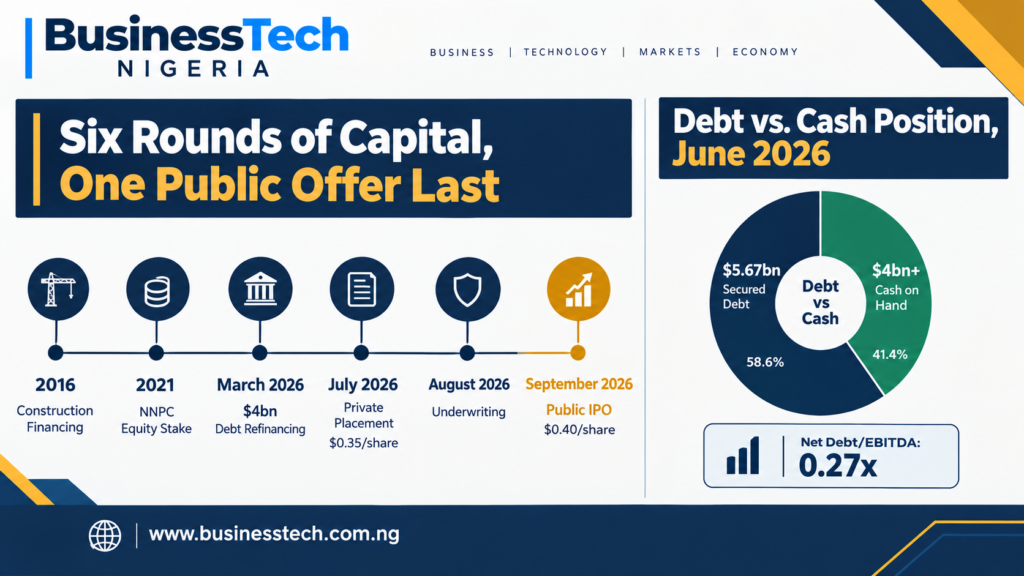
For completeness, the debt-adjusted picture. Total secured debt was $5.67 billion at 30 June 2026, down from $6.24 billion at the end of 2025, and management indicated more than $4 billion of cash on the balance sheet at end-June. That puts net debt somewhere in the region of $1.4 billion to $1.7 billion, which is broadly consistent with the disclosed net debt to EBITDA ratio of 0.27 times. Enterprise value at the offer price is therefore roughly ₦67 trillion, or about $51 billion, and EV/EBITDA on annualised first-half EBITDA of $5.2 billion is around 9.7 times.
Against global comparables, that is not a bargain. Valero traded at about 8.20 times trailing EV/EBITDA in mid-September 2026, Marathon Petroleum at 9.13 times in late May, Phillips 66 at 11.55 times, Par Pacific at 3.54 times, with a broader industry average cited around 5.81 times. Dangote Refinery is being offered at a premium to the average listed refiner, on peak-cycle EBITDA, in naira, with a 3.3 per cent float.
The bull’s answer to that comparison is that Dangote is not a normal refiner: it is newer, more complex, growing capacity by 100 per cent, enjoys a free zone tax position, and sits next to both a large captive market and a major crude basin. That answer has genuine force, and we will test it properly in the bull case section.
The point for now is narrower. You cannot evaluate ₦525 by looking at ₦525.
The Cake Analogy: Affordable and Cheap Are Different Words
The minimum application is 10 shares, or ₦5,250. That number was chosen deliberately, and it has done its job: the offer is being described everywhere as the people’s IPO, and the company is targeting up to 10 million retail investors.
₦5,250 is affordable. It is not the same thing as cheap, and conflating the two is the most common error retail investors make anywhere in the world.
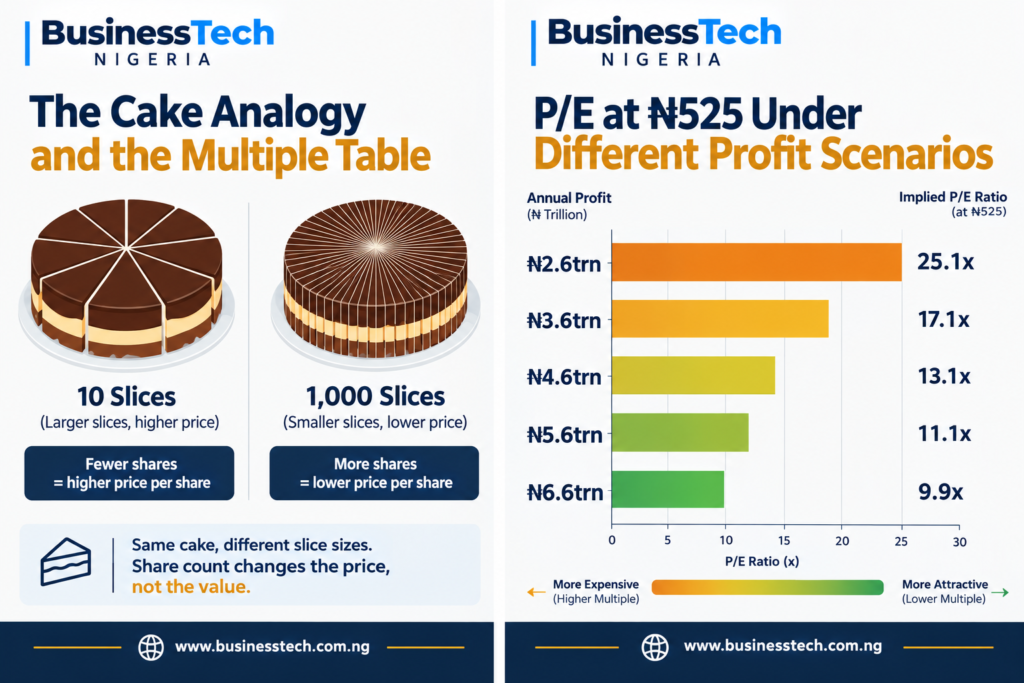
Think of a company as a cake and a share as a slice. The person selling the cake decides how many slices to cut it into. Cut a cake into ten slices and each slice looks expensive. Cut the identical cake into a thousand slices and each looks like a bargain. The cake has not changed. Only the cutting has.
Now look at what is actually trading on the Nigerian Exchange right now, and how badly share price alone misleads you.
| Company | Share price | Market value |
|---|---|---|
| Nestlé Nigeria | ₦2,995.00 | ₦2.37 trillion |
| Nigerian Breweries | ₦82.45 | ₦2.55 trillion |
| BUA Foods | ₦760.60 | ₦13.69 trillion |
| Dangote Sugar Refinery | ₦72.00 | ₦874.58 billion |
Nigerian Breweries trades at ₦82 and Nestlé at ₦2,995, a price thirty-six times higher. Yet Nigerian Breweries is the larger company by market value. An investor who bought Nigerian Breweries because it “looks cheap” and avoided Nestlé because it “looks expensive” would have been reasoning about slice size while believing they were reasoning about value.
Dangote Refinery has been cut into an unusually large number of slices. At 120.13 billion existing shares, it has roughly ten times the share count of Dangote Cement and more than eight times that of Dangote Sugar. That is why a company worth ₦65.22 trillion, which would be the largest on the Exchange by a wide margin and would add about 41 per cent to the entire market’s ₦157.59 trillion value, can be entered for ₦5,250.
There is nothing improper about this. A low unit price is standard practice for an offer aimed at mass retail participation, and it genuinely widens access in a country where most households cannot commit ₦500,000 to a single stock. Broad ownership of a national industrial asset is a reasonable policy objective, and Nigeria’s capital market is better for having it.
The risk is psychological, and it is worth naming plainly. A small ticket size lowers the amount of thinking people do before committing. ₦5,250 feels like the price of a decision that does not need analysis. But whether you invest ₦5,250 or ₦5.25 million, you are buying at exactly the same valuation: about 13 times peak-cycle earnings, 9.7 times enterprise value to peak-cycle EBITDA, ₦65.22 trillion of equity value, for a 3.41 per cent slice of a company in which the founder retains roughly 89.25 per cent after the offer.
The affordability of the ticket does not change the price of the asset. It only changes how many people buy it without checking.
Two practical implications follow.
First, size your position by conviction, not by the minimum. The fact that the minimum is ten shares tells you what the issuer wants, not what you should own. If your analysis supports a larger position, the minimum is irrelevant. If your analysis does not support a position, ₦5,250 is not a small investment, it is a small mistake, and small mistakes made by ten million people at once tend to have consequences for how those people feel about the stock market for a decade afterwards.
Second, expect the affordability narrative to persist after listing. When the shares begin trading in November, some portion of commentary will describe any price below some round number as cheap, and any price above it as expensive. Those statements will be about the slice. Your return will be determined by the cake.
We can now turn to the cake itself.
Calculations that are our own and clearly labelled as such: earnings per share, price-to-earnings ratios, earnings yields and the scenario table are derived by us from the reported ₦2.50 trillion first-half profit and a post-offer share count of 124.23 billion. The enterprise value and EV/EBITDA figures are our estimates built from disclosed gross debt of $5.67 billion and management’s indication of more than $4 billion of cash at end-June; the prospectus does not appear to publish a single headline enterprise value, and the exact net debt figure depends on whether the disclosed 0.27 times ratio uses half-year or annualised EBITDA.
One discrepancy worth flagging for readers comparing coverage. The prospectus reports in US dollars, and its naira financial figures imply a conversion rate of roughly ₦1,375 to the dollar, while the valuation reference rate stated in the prospectus is ₦1,319.54. THISDAY published the same results at ₦1,400, producing revenue of ₦19.47 trillion and profit of ₦2.55 trillion against the ₦19.13 trillion and ₦2.50 trillion used here. The underlying dollar results are identical in all three cases.
The Real Number Is ₦65 Trillion
Forget ₦525 now. For the rest of this article the number that matters is ₦65.22 trillion, because that is what the market is being asked to pay for the whole company, and it is against that figure that every future naira of profit has to be measured.
Some context for how large it is.
Nigeria’s entire quoted equity market was worth ₦157.59 trillion on 11 September 2026. Admitting the refinery at ₦65.22 trillion would add roughly 41 per cent to that in one listing and lift total quoted equity value above ₦225 trillion. Aliko Dangote told the Facts Behind the Offer presentation that the listed Dangote companies would then represent an equity cluster of approximately ₦83.5 trillion on the Exchange. A single company would account for a share of the market that no company has ever held in Nigeria.
Now a comparison that matters more than the domestic ones. The refinery cost about $20 billion to build. At ₦525 the equity is valued at roughly $47 billion to $49 billion depending on the exchange rate applied, and the enterprise value is around $51 billion. The offer values the asset at roughly two and a half times what it cost to construct.
That is not by itself a criticism. A plant that works is worth more than a plant that might work, and the ten years of construction risk, financing risk and commissioning risk have been absorbed by someone else. Buyers of completed infrastructure routinely pay a premium to build cost, and they should. But the premium is the thing you are buying, and it deserves to be stated plainly rather than buried. You are not being offered the refinery at cost. You are being offered it at cost plus roughly $30 billion.
There is a second reference point, and it is unusually clean because it happened seven weeks ago. In July 2026 the company completed a $2.5 billion private placement at $0.35 per share, oversubscribed 3.7 times, with a 365-day lock-up, attracting investors including Africa Finance Corporation and India Infra Buildco. That placement implied a valuation of roughly $40 billion and created the 7.148 billion shares now classified as “Others” in the ownership structure. In August a $1 billion underwriting programme followed, comprising a funded $600 million tranche and a $400 million commitment supporting the public offer.
The IPO price of about $0.40 per share therefore sits roughly 14 per cent above what institutional investors paid in July, and the implied valuation sits about 17.5 per cent above the valuation implied by that placement.
Retail investors should understand what they are looking at. Sophisticated institutions with access to the same prospectus, the same management and considerably more negotiating power bought at $0.35 and accepted a one-year lock-up in exchange. The public is being offered the same asset at $0.40 with no lock-up, seven weeks later. The step-up is not scandalous, and part of it is explained by better disclosed numbers and momentum in the business. It is simply a data point, and a useful one, because private market pricing is often the most honest signal available about what informed money thinks an asset is worth.
Now the central question of the whole article. What does ₦65.22 trillion demand of the future?
Work backwards. Suppose you want 15 per cent a year in naira over ten years, which is a reasonable target for equity risk in a country where a one-year Treasury bill pays about 16.62 per cent. Fifteen per cent compounded for ten years multiplies your money roughly 4.05 times. If you receive no dividends at all, the company’s equity value must reach about ₦264 trillion by 2036. If the market still values it at 12 times earnings then, annual profit must be about ₦22 trillion, against roughly ₦5 trillion annualised today. Profit must quadruple, in naira, and hold there.
Dividends soften the requirement considerably. If the company eventually distributes enough to average a 4 per cent dividend yield across the decade, the share price only needs to compound at about 11 per cent, equity value needs to reach roughly ₦185 trillion, and profit at a 12 times exit multiple needs to be about ₦15.4 trillion. Still roughly three times current annualised earnings.
This is the honest shape of the investment. It is not impossible. Doubling capacity to 1.4 million barrels per day, running it at 90 per cent rather than 83.6 per cent, and holding a mid-cycle margin would get a serious distance toward those numbers. But the required outcome is demanding, and it is demanded of a business whose margin is set by global markets rather than by its own management.
Which brings us to the risk that most retail investors have never heard of and that does more damage than any other.
Multiple compression. A company can grow its earnings substantially and still deliver a poor return, if the valuation multiple investors are willing to pay falls faster than earnings rise.
Consider a scenario in which everything operational goes well. Profit grows from ₦5 trillion to ₦10 trillion over five years, a doubling. But by 2031 refining margins have normalised, the market has remembered that refining is cyclical, and it applies 8 times earnings rather than 13. Equity value is then ₦80 trillion. Against ₦65.22 trillion, that is a gain of 22.6 per cent over five years, about 4.2 per cent a year, before any dividends. The company doubled its profit and the shareholder earned less than a savings account.
The table below shows the arithmetic across a range of outcomes. It is our own calculation, using ₦65.22 trillion as the entry value and a five-year horizon, and it excludes dividends.
| 2031 annual profit | Exit multiple | Implied equity value | Annual return from ₦65.22trn |
|---|---|---|---|
| ₦12 trillion | 14x | ₦168 trillion | 20.9% |
| ₦10 trillion | 12x | ₦120 trillion | 13.0% |
| ₦10 trillion | 8x | ₦80 trillion | 4.2% |
| ₦7 trillion | 10x | ₦70 trillion | 1.4% |
| ₦5 trillion | 8x | ₦40 trillion | negative 9.3% |
Three of those five rows involve a company that is larger and more profitable than it is today. Two of them still produce a disappointing outcome for someone who bought at ₦525.
That is the lesson to carry through everything that follows. Your return is not determined by whether the refinery succeeds. It is determined by the gap between what you paid for the success and how much success actually arrives.
From a Loss to ₦2.5 Trillion: Reading the Recent Numbers Properly
The financial turnaround in this business is real, large, and recent. It is also worth taking apart, because the way a profit is earned tells you more about its durability than the size of the profit does.
Here is the record as disclosed in the prospectus.
| 2024 | 2025 | H1 2026 | |
|---|---|---|---|
| Revenue | ₦9.38 trillion | ₦18.73 trillion | ₦19.13 trillion |
| Gross profit | not separately cited here | ₦343.4 billion | ₦3.43 trillion |
| Profit after tax | loss of about $1.51 billion | loss of ₦723 billion (about $476 million) | ₦2.50 trillion (about $1.82 billion) |
| Gross refining margin | $10.70 per barrel | $13.70 per barrel | $24.50 per barrel |
Six months of 2026 produced more revenue than the whole of 2025. Gross profit went from ₦343.4 billion for a full year to ₦3.43 trillion in half a year, a tenfold increase on twice the time base. EBITDA reached $2.60 billion in the first half against $545.3 million for all of 2025. Net cash from operating activities was ₦1.751 trillion. Total assets stood at ₦29.07 trillion and net debt to EBITDA at 0.27 times. Cumulative losses of roughly $1.99 billion across 2024 and 2025 were erased in two quarters.
Nobody should minimise this. A refinery that many informed people believed would never run properly is now running at 83.6 per cent average utilisation, exporting jet fuel to Europe in volumes that displaced the United States, and generating serious cash. The operational execution has been better than most sceptics expected.
Now the harder work. What produced the swing, and how much of it repeats?
Driver one: operational ramp-up. Volume rose because the plant finally worked. Utilisation improved, the plant reached and exceeded nameplate capacity, and enormous fixed costs were spread over far more barrels. This is the most durable driver of the three. It reflects engineering and management, it is largely within the company’s control, and there is still room to run toward the 94 per cent utilisation that a mature operator like Marathon Petroleum achieves. Growth from this source should be expected to continue.
Driver two: margin. The gross refining margin nearly doubled, from $13.70 per barrel in 2025 to $24.50 in the first half of 2026, with the first quarter at $33.70. This is the least durable driver. It is set in global markets and was substantially inflated by supply disruption linked to the Iran conflict. Every listed refiner enjoyed the same windfall, which is why Marathon, Valero and HF Sinclair each gained more than 80 per cent in 2026 while the US crack spread ran near $59 to $70 per barrel against a ten-year average closer to $21.68. Renaissance Capital’s full-year forecast of $27.55 per barrel is a fair anchor for this year. It should not be an anchor for 2030.
Driver three: the absence of commissioning costs. The 2024 and 2025 losses were partly the cost of starting a plant of this complexity. Those costs do not recur, which flatters the year-on-year comparison without telling you anything about the future.
A rough decomposition is instructive. Revenue roughly doubled year-on-year in the first half while the gross margin per barrel also roughly doubled. Volume and margin are multiplicative, not additive, which is why profit moved from a loss of about $282 million in the first half of 2025 to a profit of $1.82 billion in the first half of 2026. A business with high fixed costs and a volatile spread produces exactly this kind of violent swing, in both directions.
Now the number that receives the least attention and deserves far more.
Net cash from operating activities in the first half was ₦1.751 trillion, roughly $1.27 billion. Planned capital expenditure is $4.8 billion for the remainder of 2026, $3.9 billion in 2027 and $3.1 billion in 2028.
Set those side by side. Operating cash generation of somewhere between $2.5 billion and $3.5 billion a year on current form, against capital spending of $11.8 billion over two and a half years. Free cash flow, which is what actually pays dividends, is going to be deeply negative for several years even if profits are excellent.
This is not a sign of distress. It is what a company doing a $14.3 billion expansion looks like, and it is precisely why the company is raising ₦2.15 trillion from the public. But it has a direct consequence for the shareholder who is buying partly in expectation of income. Any dividend paid over the next three years is likely to be funded, in economic substance, either by borrowing or by the equity being raised from new shareholders, not by surplus cash the business has no other use for.
Management has expressed an intention to generate returns in dollar terms and has discussed paying shareholders on that basis, and Aliko Dangote has said the refinery should be viewed as an African rather than a purely Nigerian investment. Treat management intentions as intentions. Dividends depend on profitability, cash flow, board recommendation, shareholder approval and regulation, and the prospectus does not guarantee an amount or a currency. The prospectus itself confirms dividends will be paid only if and when declared.
One further item that belongs in any assessment of earnings durability. The refinery operates in a free zone, and its tax benefits depend on no more than 25 per cent of its sales going into the Nigerian domestic market, with profits from domestic sales potentially becoming taxable from 1 January 2028. An investor extrapolating today’s after-tax margin into the 2030s should ask what the number looks like with a normal tax rate applied to a growing domestic book. That is a structural change with a date attached to it, sitting inside the forecast period, and it is disclosed in the prospectus rather than hidden.
So the fair summary of the recent numbers is this. The operational improvement is genuine and partly repeatable. The margin improvement is genuine and largely not repeatable at this level. The cash flow is strong at the operating line and negative after investment. And the tax position changes in about fifteen months.
Don’t Confuse a Great Story with a Great Investment
Within the first hour of the offer opening this morning, investors committed ₦1.5 trillion.
That is roughly 70 per cent of the entire ₦2.15 trillion base offer, absorbed in sixty minutes. It tells you something true and impressive about Nigerian appetite for this asset. It also tells you something important about the conditions under which you are making a decision, because demand of that intensity is not generated by discounted cash flow models. It is generated by a story.
And this is a magnificent story. A Nigerian built, against considerable scepticism, the largest single-train refinery in the world, on Nigerian soil, processing Nigerian crude, ending a humiliating dependence on imported fuel, and now sells jet fuel to Europe in volumes that displaced the United States. He is offering a piece of it to drivers and cooks for ₦5,250. If you are Nigerian, and you are not moved by that, you may want to check your pulse.
Here is the difficulty. Everything in the preceding paragraph is true, and none of it is an investment argument.
A story tells you what a company has done. A valuation tells you what you must pay for what it will do. The most dangerous moment in any market is when a true story is used as a substitute for a price analysis, because the truth of the story makes the absence of the analysis feel unnecessary.
History is not short of examples. The companies at the centre of the most compelling narratives are frequently the ones that deliver the worst returns to the investors who arrived at the peak of the enthusiasm, not because the narrative was false but because the narrative had been fully paid for in advance. The business performed. The shareholders did not.
There are three specific reasons to hold the story at arm’s length here.
First, the scale of the demand is itself a risk factor. Some of the money flowing into this offer is coming out of other Nigerian shares, and Nigerian equities swung to ₦1.88 trillion in losses in one week as institutions repositioned ahead of the offer. When an offer of this size absorbs a large share of available domestic liquidity, the immediate aftermath of listing is driven by flows rather than fundamentals. That can push the price in either direction, and neither direction will tell you anything about whether ₦525 was a sensible price.
Second, the float is very thin. Only about 3.41 per cent of the company is being sold, and the founder retains roughly 89.25 per cent after the offer. A small free float in a heavily demanded stock tends to produce volatile trading and prices that can detach from any defensible valuation for extended periods, upward as well as downward. It also means minority shareholders have essentially no influence over capital allocation, dividend policy or related-party dealings. You are a passenger. The quality of the driver becomes a central part of the investment case, and the driver here has a long record of building things and a correspondingly long record of retaining control of them.
Third, the research you are reading is not disinterested. CardinalStone’s 12-month target price of ₦688.09 and equity valuation of ₦77.7 trillion, and Chapel Hill Denham’s fair value estimate of $62.53 billion or ₦82.62 trillion, both sit above the offer valuation. CardinalStone is also a joint issuing house on the transaction, though its report states the analysts’ views were independently determined. This is normal market practice and not evidence of wrongdoing. It is a reason to read those targets as one input among several rather than as an objective appraisal, and to notice that no widely circulated research published during an offer period ever concludes that the offer is expensive.
None of this means the story is wrong. It means the story and the price are separate questions, and only one of them has been extensively covered in the Nigerian press this month.
So hold both thoughts. This is one of the most consequential industrial assets ever built on the African continent, and it may also be fully priced at ₦525. Those statements do not conflict. The investor’s job is not to decide whether to admire the refinery. It is to decide what the refinery is worth, and then to compare that with what is being asked.
We turn next to a belief that is quietly costing Nigerian investors money this month: the idea that buying at the IPO means getting in early.
Our own calculations, labelled as such in the text: the required-return arithmetic (the ₦264 trillion and ₦185 trillion equity values, and the ₦22 trillion and ₦15.4 trillion earnings requirements), the multiple compression table, and the observation that the offer values the asset at roughly two and a half times its approximate $20 billion construction cost. The 2024 gross profit figure is not separately cited in the sources reviewed and has been left blank rather than estimated.
The Prediction: What If the Middle East Crisis Ends and the Strait of Hormuz Reopens?
There is another question investors should ask that may not be answered by looking only at Dangote Refinery’s impressive recent numbers: what happens when today’s extraordinary oil-market conditions disappear? The current Middle East crisis has disrupted crude and refined-product flows through the Strait of Hormuz, pushed oil prices sharply higher and contributed to unusually strong refining margins. That environment can create a powerful tailwind for refiners because when global supplies of refined products become tighter, the value of the products coming out of a refinery can rise relative to the cost of the crude going in. The danger for an investor is assuming that today’s margins are a permanent feature of the business. They are not. If the conflict ends, the Strait of Hormuz returns to normal operation and Gulf crude and petroleum products begin flowing freely again, some of the scarcity premium could disappear. More crude becomes available, shipping routes normalise, competing refineries regain access to feedstock and the exceptional margins created by disruption could begin to compress. That does not mean Dangote Refinery becomes a bad business. It means investors would finally get a clearer picture of how profitable the refinery is under more normal conditions rather than crisis conditions.
That is why I believe the more important prediction is not whether Dangote Refinery will make money. It almost certainly has the potential to remain a strategically important and highly profitable industrial asset. The harder question is how much of that future profitability is already reflected in a valuation of roughly ₦65 trillion at the IPO price of ₦525. The company is simultaneously asking investors to believe in continued high utilisation, reliable crude supply, strong refining economics and a successful $14.3 billion expansion towards 1.4 million barrels per day. If geopolitical conditions normalise, while additional refining capacity comes on stream in Nigeria and elsewhere, competition for crude and customers could become more important. BUA’s planned refinery development, the rehabilitation of Nigeria’s existing NNPC refineries and other emerging refining projects, including developments involving Aradel and projects in Akwa Ibom, are therefore worth watching. The long-term question is not whether Dangote can dominate the market today. It is whether it can continue generating returns above its cost of capital when the market becomes more competitive, crude supply becomes less constrained and refining margins return closer to historical levels. That is the scenario I would want every investor to model before deciding what ₦525 is really worth.
An IPO Does Not Mean Getting In Early
There is a phrase attached to almost every retail IPO campaign in the world, and it has attached itself to this one too: get in early, before everyone else discovers it.
It is worth stating plainly that this is not what is happening here, and understanding why matters more than it might first appear.
Dangote Refinery began refining operations in February 2024. By the time public retail investors are permitted to buy a single share, the plant will have been running for two years and eight months. It will have moved through its most dangerous phase, commissioning, when a project of this complexity most commonly fails or disappoints. It will have absorbed roughly $1.99 billion of combined losses in 2024 and 2025 and converted into a $1.82 billion first-half profit in 2026. It will have been valued privately at roughly $40 billion in a placement in July, financed by sophisticated institutions including Afreximbank, Access Bank and Africa Finance Corporation, all of whom did their own due diligence with resources far exceeding what any retail investor can bring to bear.
None of that describes early. It describes late, in the specific and important sense that matters to an investor: the uncertain, high-risk, potentially highest-reward phase of this company’s life is already over, and someone else was paid to take that risk.
Consider who has already been compensated for bearing the risk that retail investors are now being asked to admire from a distance. Afreximbank has invested roughly $15 billion in the Dangote Group since 2015 and led a $2.5 billion share of a $4 billion syndicated term loan in March 2026, priced to reflect construction and ramp-up risk. Access Bank co-arranged that facility. Africa Finance Corporation moved from a $300 million senior lending position into equity in July, having already recovered its earlier debt capital, entering the private placement once the asset had de-risked into a growth phase rather than a construction phase. NNPC has held an equity stake since 2021, financed in part by pledging 35,000 barrels per day of crude supply against a $1.036 billion facility, and is reportedly seeking to increase its stake from around 7.2 per cent back toward 20 per cent specifically because the growth phase, not the construction phase, is now underway.
Every one of those parties was compensated with a lower entry price, a debt coupon, a negotiated equity discount, or preferential terms, precisely because they took on risk before the outcome was known. The retail investor buying at ₦525 this month is buying after the outcome is largely known. That is a perfectly legitimate thing to do. It is simply not early.
This distinction matters because “early” is doing a lot of unearned work in the marketing of this offer, and in the psychology of the people applying for it. Getting in early implies a scarcity that does not exist here: 120.13 billion shares already exist, held overwhelmingly by one family and a small number of institutions who arrived through five separate financing rounds, from the original 2016 construction financing through the 2021 NNPC stake, the March 2026 debt refinancing, the July private placement and the August underwriting programme. The public offer, at 4.1 billion shares, is the sixth or seventh capital event in this company’s history, and the smallest and latest by valuation.
There is a version of this argument that Aliko Dangote himself has made publicly, and it deserves to be stated fairly. He has argued that broadening ownership among ordinary Nigerians, even at a mature valuation, is a legitimate act of national economic inclusion, not merely a pricing exercise. There is real merit in that framing. A country is better served by having millions of citizens hold a direct stake in a strategic industrial asset than by having that asset held entirely by a handful of institutions and a single family. Democratised ownership has value beyond the internal rate of return on any individual’s ₦5,250, and it is fair to credit that motive alongside the commercial one.
But inclusion and bargain are different gifts. You can be included in ownership of a wonderful asset at a full price. Recognising that the price is full, and buying anyway for reasons beyond pure return, is a coherent decision. Buying because you believe you are getting a discount that early institutional investors did not get is not coherent, because the evidence points the other way. The July placement priced the same equity roughly 14 to 17.5 per cent below where the public offer prices it, seven weeks earlier, with a lock-up attached. The public investor is paying more, for a shorter commitment, with less information than the placement participants had, and with no seat at any table.
None of this is an argument against subscribing. It is an argument against subscribing for the wrong reason. If your reason is “I want exposure to Africa’s largest industrial asset and I accept the current price,” that survives scrutiny. If your reason is “I am getting in before the smart money,” it does not, because the smart money got in first, at a better price, months ago.
The $14 Billion Expansion, Examined as an Investment Decision
Every commentary on this IPO repeats the expansion headline: capacity is doubling from 700,000 to 1.4 million barrels per day, at a cost estimated at $14.3 billion, with a target of 2028 to 2030 and Aliko Dangote’s ambition of making it the world’s largest single-train refining complex.
The headline tells you the company is getting bigger. It tells you nothing about whether getting bigger is good for you as a shareholder. Those are different questions, and the second one is the only one that matters to your return.
Growth creates shareholder value only when the return earned on the incremental capital exceeds the cost of that capital. If the expansion earns more than it costs to finance, every dollar invested becomes worth more than a dollar to shareholders. If it earns less, the company becomes larger while shareholders become poorer per share, because capital that could have been distributed or invested elsewhere was instead committed to a project that destroyed value at the margin. Size and value are not the same thing, and a great deal of Nigerian corporate history, in sectors well beyond oil, has demonstrated this the hard way.
So put the expansion through that test, using the information available.
What is being built, and why. The programme adds a second crude distillation unit, construction of which began in January 2026, intended to add roughly another 700,000 barrels per day. Combined with existing debottlenecking headroom, this could eventually take the complex toward 1.4 to 1.45 million barrels per day. The declared capital schedule is $4.8 billion for the remainder of 2026, $3.9 billion in 2027, and $3.1 billion in 2028, a total of $11.8 billion disclosed through that period against the $14.3 billion headline figure for the full programme.
What additional revenue could it theoretically generate. This is where scenario labelling matters more than false precision. If the new unit ran at a similar utilisation to the existing plant, roughly 84 per cent, and captured a similar refining margin to the H1 2026 average of $24.50 per barrel, incremental annual gross margin from an additional 700,000 barrels per day would be in the order of $5 billion. Apply a normalised margin closer to the Renaissance Capital full-year forecast of $27.55 per barrel and the figure moves higher; apply a mid-cycle margin closer to the 2024-2025 average of around $12 per barrel and it falls to roughly $2.6 billion. These are not forecasts. They are illustrations of how sensitive the entire investment case is to a single number, the margin per barrel, that the company does not control.
Who finances it, and at what cost. Financing is now genuinely diversified rather than resting on one instrument. In March 2026, Afreximbank and Access Bank co-arranged a $4 billion senior syndicated term loan, with Afreximbank underwriting $2.5 billion of it as a five-year facility explicitly designed to consolidate existing debt and align the balance sheet with the company’s operational maturity rather than its construction phase. Afreximbank has separately said it has invested roughly $15 billion in the Dangote Group since 2015 and has supported the refinery since 2024 with a $1 billion working capital facility, and has acted as financial adviser on a Naira-for-Crude initiative intended to reduce the company’s dependence on foreign currency for crude purchases and product sales. On top of that sits the $2.5 billion July equity placement and the $1 billion August underwriting programme, and now the ₦2.15 trillion public offer. The expansion is therefore being funded through a genuine mix of syndicated bank debt, strategic equity and public equity, which is a materially healthier structure than relying on a single lender or a single instrument, and it reduces refinancing concentration risk relative to where the company stood in 2024.
What could go wrong. The prospectus itself is candid about the central constraint: expanding to 1.4 million barrels per day is dependent on securing adequate crude supply to run the enlarged facility at or near capacity, and the Domestic Crude Supply Obligation framework covers, at most, 350,000 barrels per day, subject to availability, with Nigerian crude receipts having already eased from around 650,000 barrels per day in May 2026 to 575,000 in June. Doubling capacity without a corresponding increase in secured, competitively priced crude simply doubles the company’s exposure to the international spot market, where it competes against every refiner on earth, including US Gulf Coast and European refiners with decades of established supply relationships.
Beyond crude, the standard risks of any large industrial construction project apply in full: cost overruns are common in projects of this scale and complexity, and the existing plant itself took roughly two and a half years to move from 650,000 to 700,000 barrels per day through de-bottlenecking alone, suggesting that timelines in this business tend to slip rather than compress. A second crude distillation unit is a materially larger undertaking than de-bottlenecking an existing one. If completion slips from 2028 toward 2030, capital is tied up for longer without generating a return, which mechanically lowers the return on that capital even if the eventual operating economics are unchanged.
There is also a demand-side risk that receives less attention than it deserves. The expansion assumes markets exist for a further 700,000 barrels per day of refined product, in a decade when global oil demand growth is slowing, when Africa’s own refining capacity is increasing elsewhere, including Dangote’s own planned refinery in Kenya, and when the energy transition is gradually reducing demand growth for some of the products this plant produces, even as demand for others, including petrochemical feedstocks, may continue to grow. We will return to these longer-horizon questions in the bull, base and bear case sections that follow later in this article.
Does the expansion create shareholder value, or simply make the company bigger. The honest answer, given what is disclosed, is that nobody outside the company can currently calculate a reliable return on the incremental $14.3 billion, because the two inputs that determine it, the refining margin the new capacity will earn and the utilisation it will achieve, are precisely the two inputs that are least predictable in this industry. What can be said is that the financing structure has become more conservative and diversified since 2024, which reduces the risk of a funding crisis derailing the project, and that the operational team has already demonstrated an ability to bring the existing unit from construction through to a genuinely profitable operating phase, which is meaningful evidence of execution capability even though it does not guarantee the second unit will follow the same path on the same timeline.
Shareholders are being asked to fund roughly a third of a $14.3 billion programme through this offer and prior placements, on the basis of a plan whose completion date has already moved within public statements from “by 2028” to “by 2029” to “by 2030” depending on the source and the month. That kind of drift is normal for projects of this scale. It is still drift, and a responsible investor prices it in rather than assuming the earliest date quoted will be the one that holds.
The Debt: $5.7 Billion, and What It Actually Represents
Total secured debt stood at $5.67 billion at the end of June 2026, down from $6.24 billion at the end of 2025, a reduction of $570 million achieved as the company raised output and sales ahead of the offer. Every figure in that sentence is precisely disclosed. What it means for a shareholder requires several further questions that the headline number does not answer on its own.
Is this corporate debt or project debt? It is project and corporate debt of the operating entity itself, DPRP FZE, the same company whose shares are being sold. It is not debt sitting inside a separate holding structure shielded from the operating business, and it is not debt of a parent company that shareholders in the refinery are insulated from. Anyone buying shares in this offer is buying equity that sits behind this debt in the capital structure, meaning debt holders are repaid before any dividend reaches a shareholder, and meaningfully before any shareholder is repaid in a liquidation scenario, however remote that scenario currently appears.
What currency is it denominated in, and what does that mean? It is dollar-denominated, secured borrowing. This is, in one specific and important sense, a source of comfort rather than alarm for a Nigerian industrial company, because the refinery’s revenue is also substantially dollar-linked, through export sales and dollar-referenced domestic pricing. A company that borrows in dollars while earning in naira has a currency mismatch that can become dangerous very quickly, as many Nigerian companies discovered during past devaluations. A company that borrows in dollars while earning a large share of its revenue in dollars has matched its liability to its income, which is the textbook prudent structure for this kind of financing. This does not eliminate currency risk for the Nigerian shareholder, whose shares trade in naira and whose eventual dividend, if paid in naira, will be converted at whatever rate prevails, but it substantially reduces the risk that currency movements alone threaten the company’s ability to service its obligations.
What is the interest burden, and can operating cash flow cover it? The company discloses a net debt to EBITDA ratio of 0.27 times as of June 2026, which by any conventional industrial or banking standard is a conservative, comfortably serviceable level. For comparison, ratios below 1.0 times are generally considered strong for capital-intensive industrials, and many well-regarded global companies operate for extended periods above 2.0 times without triggering solvency concern. At 0.27 times, annualised EBITDA of roughly $5.2 billion comfortably covers debt service several times over on current earnings, even before accounting for the cash balance of more than $4 billion the company held at the same date.
What is the maturity profile, and is there refinancing risk? The March 2026 refinancing was explicitly structured as a five-year facility designed to consolidate prior, shorter-dated financing and align the balance sheet with the company’s operational maturity rather than its construction risk. A five-year tenor, arranged by Afreximbank and Access Bank as co-lead arrangers with broad syndicate participation, is a materially healthier maturity profile than the shorter-dated construction financing that preceded it, and it substantially reduces near-term refinancing risk. The company will still need to arrange further financing for the remaining, larger tranches of the $14.3 billion expansion programme, and the terms of that future financing are not yet known.
What happens if the naira depreciates further? Because the debt is dollar-denominated against substantially dollar-linked revenue, a naira depreciation on its own does not mechanically threaten the company’s ability to service this specific debt, in the way it would for a company borrowing in dollars against naira revenue. It does, however, affect the Nigerian equity holder’s return when measured in naira relative to the underlying dollar economics of the business, a point we return to in detail in the currency section later in this article.
Does the debt finance productive assets, and should it be considered alarming or reasonable? The debt financed the construction of an asset that is now demonstrably generating $2.60 billion of EBITDA in a single half-year and has moved decisively from a loss-making construction phase into a profitable operating phase. Judged against the standard test of whether debt is dangerous, which is whether it finances an asset capable of servicing it from its own cash generation, this debt currently passes that test comfortably. The distinction between “the company has debt” and “the company’s debt is dangerous” is precisely the distinction this refinery currently sits on the safe side of.
The appropriate caution is forward-looking rather than backward-looking. Today’s comfortable 0.27 times ratio is a snapshot taken at the peak of a refining margin cycle described earlier in this article as unusually favourable and likely to normalise. If EBITDA falls toward the $2.6 billion to $3 billion annualised range implied by more normal margins, rather than the roughly $5.2 billion implied by annualising the exceptional first half, the same $5.67 billion of debt, even after further paydown, would sit against a materially higher leverage ratio, though still not an alarming one on the numbers currently available. And the company is about to add a further, currently undetermined amount of debt to fund the remaining tranches of the expansion programme, which means the comfortable ratio disclosed today is a point-in-time figure for a balance sheet that is actively being reshaped, not a stable, ongoing characteristic of the business.
A shareholder’s honest conclusion on debt, at this stage, is that it is currently well-structured, prudently currency-matched, and comfortably serviceable, financed by increasingly diversified and sophisticated lenders rather than a single concentrated source. It is not currently a reason for alarm. It is, however, a variable that will grow in absolute size over the next several years as the expansion is funded, and its comfort level five years from now will depend far more on where refining margins settle than on anything management does with the debt itself.
Calculations that are our own and labelled as such: the incremental revenue scenarios for the expansion (the roughly $5 billion, higher, and $2.6 billion illustrations), the annualised EBITDA figure of approximately $5.2 billion used for the leverage discussion, and the observation about the drift in the expansion’s publicly stated completion date across sources. The prospectus’s own projected return on the expansion’s incremental capital is not disclosed in the sources reviewed and has not been estimated as a single figure, given how sensitive it is to unknowable future margins.
The Bull Case: What Could Go Right
A bull case is only useful if it is specific enough to be wrong. Vague optimism about Africa’s future is not an investment thesis. Below are the concrete mechanisms that could make ₦525 look, in ten years’ time, like a price today’s buyers were fortunate to get.
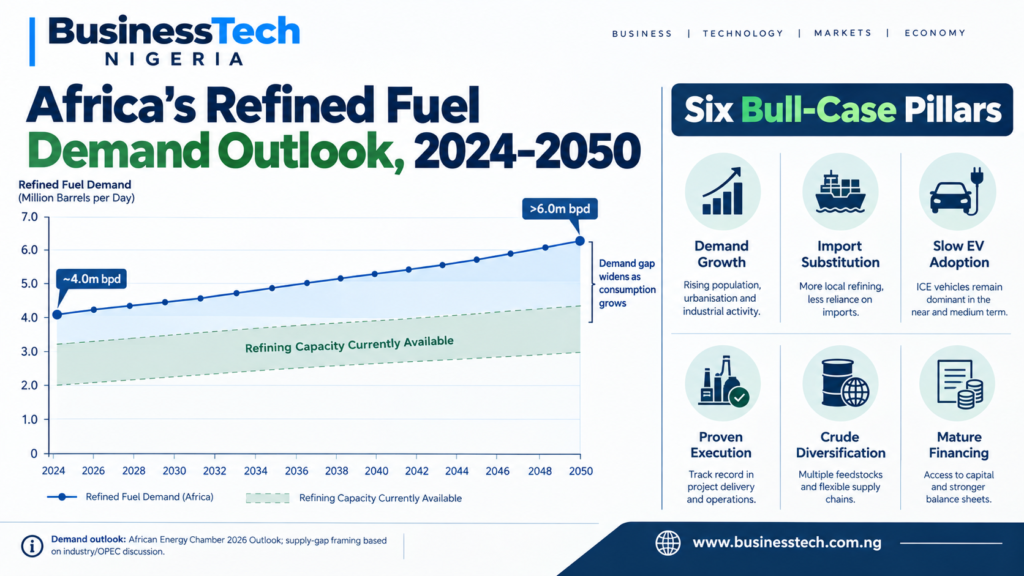
One: structural demand growth that has nothing to do with the current margin cycle. Africa’s demand for refined oil products is projected by the African Energy Chamber to rise from roughly 4 million barrels per day in 2024 to more than 6 million by 2050, with the continent expected to lead global gasoline demand growth over the long term and gasoline consumption alone projected to exceed 2.2 million barrels per day by 2050. Nigeria already dominates continental gasoline demand while its per capita usage remains comparatively low, meaning the ceiling has not been reached even domestically. Vehicle ownership across Africa is expected to almost treble per capita by 2030, and the continent’s urban population is projected to grow at 3.6 per cent a year, adding roughly 950 million urban residents by 2030 who will need to move around. This is demand growth that would exist regardless of what happens to short-term refining margins, and it is the single strongest structural argument in favour of the expansion.
Two: Nigeria still imports most of its own petrol, and Africa still imports most of its own fuel. Despite the Dangote Refinery running at 700,000 barrels per day, imported petrol accounted for 72.64 per cent of Nigeria’s total petrol consumption between October 2024 and July 2025, according to Federation Account Allocation Committee data. OPEC projects Africa faces a $100 billion refining investment gap over the next 25 years, with $40 billion needed for new refineries by 2030 alone, and the Africa Energy Chamber warns that at current project rates the continent may still be a net importer of refined products by 2050. That combination, rising demand and a persistent supply shortfall, is precisely the condition under which an established, running, cost-advantaged refiner gains market share for years without needing to invent anything new. Every barrel of imported petrol that the expanded Dangote plant displaces is a barrel of demand it did not have to create.
Three: gasoline-powered vehicles are not disappearing from African roads on any timeline that matters to this investment. The African Energy Chamber’s own 2026 outlook is explicit that electric vehicle adoption in Africa will be slow because of inadequate electricity supply and scarce charging infrastructure, concentrated mainly in South African metropolitan zones, while petrol-powered vehicles remain dominant in Nigeria and Kenya due to urban congestion patterns that favour petrol’s cold-start reliability. The Africa-wide EV market was estimated at $15.80 billion in 2024, projected to reach $25.40 billion by 2029, a meaningful growth rate from a very small base. The bear case for global refiners in wealthy markets, that electric vehicles will erode gasoline demand within a decade, does not currently apply with anything like the same force to Nigeria or to most of the African continent this refinery serves. This is a genuine structural advantage relative to a European or North American refiner facing the same investment decision.
Four: the company has already proven it can execute. Bringing a single-train refinery of this complexity from construction through commissioning to a profitable, high-utilisation operating phase is one of the hardest things an industrial company can do, and many well-financed projects globally have failed at exactly that transition. Dangote Refinery has done it, reaching 700,000 barrels per day, achieving 83.6 per cent average utilisation in the first half of 2026, and becoming the largest external supplier of jet fuel to Europe, overtaking the United States, in June and July. That is not a promise. It is a demonstrated capability, and it is reasonable to give some weight to the same management team executing the second crude distillation unit, even allowing for the fact that the second project is materially larger than the de-bottlenecking exercise that preceded it.
Five: crude procurement flexibility has genuinely improved. The refinery processed 36 different crude grades from Africa, South America, the United States and the Middle East by June 2026. That diversification, built up over less than three years of commercial operation, is a real de-risking of the single largest operational vulnerability this business has. A refinery that can run on WTI Midland, Nigerian grades, and Middle Eastern and South American crude has meaningfully more resilience against any single supply disruption than a refinery locked into one source.
Six: the financing structure has matured. The shift from concentrated, shorter-dated construction debt toward a diversified mix of a five-year syndicated term loan, strategic equity from Africa Finance Corporation, and now broad public equity reduces the probability that a financing shock alone derails the growth plan, a risk that was real and material as recently as two years ago.
Seven: the free zone tax structure, while time-limited, provides real value during exactly the years the expansion is being built. Free zone benefits currently apply as long as no more than 25 per cent of sales go into the Nigerian domestic market. As export volumes grow alongside the expansion, the company has a structural incentive, and the practical means, to keep growing its dollar-denominated export book, which supports the tax position and its dollar revenue base simultaneously.
Put these together and the bull case is coherent: a demonstrated operator, in a market with a genuine, multi-decade supply deficit, facing demand growth that is largely insulated from the risk that most worries investors in refiners in wealthier markets, financed by an increasingly diversified and mature capital structure. If margins normalise toward a healthy mid-cycle level rather than collapsing, if the expansion is completed within a reasonable distance of its stated timeline, and if crude supply keeps pace with capacity, the case for a materially larger, more valuable company by 2033 to 2036 is genuinely strong.
None of that tells you whether ₦525 is the right price for that outcome. It tells you the outcome is plausible. Price and plausibility are, as this entire article has argued, different questions.
How Could I Be Wrong
Every one of the arguments above has a specific, identifiable failure mode. A serious investor does not skip this section because it is uncomfortable. This is where the actual risk to your capital lives.
I could be wrong about margin normalisation being modest rather than severe. The base case scenarios in this article generally assume refining margins settle somewhere between the 2025 average of $13.70 per barrel and the H1 2026 average of $24.50. But margins are not obligated to stop at a comfortable midpoint. The ten-year average US crack spread to February 2026 was around $21.68, well below where 2026 has traded, and forward markets were already pricing an August 2027 spread more than 35 per cent below near-dated levels at the time of writing. If a durable ceasefire or supply normalisation in the Middle East, combined with new refining capacity coming online elsewhere in Africa or globally, pushes margins back toward or below the 2024 to 2025 range of $10.70 to $13.70 per barrel for an extended period, several years rather than one, the earnings base underpinning every valuation in this article roughly halves, and the case for ₦525 weakens substantially, regardless of how well the plant itself is run.
I could be wrong about how much crude the expansion can actually secure. The Domestic Crude Supply Obligation ceiling of 350,000 barrels per day, itself explicitly conditional on availability, already covers only half of current 700,000 barrel per day capacity. Nigerian crude receipts eased from 650,000 barrels per day in May 2026 to 575,000 in June, in the wrong direction at exactly the wrong moment for a company planning to double throughput. If Nigerian production does not grow, and it has shown no reliable trend of doing so for over a decade, the expanded plant will depend even more heavily on the international spot market, competing against US Gulf Coast and European refiners for the same barrels. That raises input costs, narrows margins, and could mean the expanded capacity runs at a persistently lower utilisation than the existing plant, undermining the entire economic logic of building it.
I could be wrong about execution risk on the second unit. The existing plant took roughly two and a half years to move from 650,000 to 700,000 barrels per day through de-bottlenecking, a comparatively modest engineering task. A second crude distillation unit of 700,000 barrels per day is a substantially larger undertaking, and the stated completion date has already been described variously as 2028 and 2029 across different company statements, with the prospectus itself framing full doubling as a 2030 objective. If costs overrun by even 20 to 30 per cent, a common outcome for megaprojects of this scale globally, the $14.3 billion programme could require $17 billion to $18.5 billion, funded by further debt or dilutive equity issuance beyond what current shareholders have priced in.
I could be wrong about the durability of the free zone tax advantage. Domestic sales exceeding 25 per cent of the total would jeopardise the free zone status, and profits from domestic sales may in any case become taxable from 1 January 2028. If the company’s growth strategy tilts more toward serving Nigeria’s own persistent import gap, which is itself a compelling growth opportunity given that 72.64 per cent of Nigerian petrol is still imported, it may do so at the cost of a less favourable tax structure than the one underpinning today’s after-tax margins. Growth and tax efficiency could pull in opposite directions.
I could be wrong about how much of the growth story is already reflected in the price. This article has repeatedly argued that ₦65.22 trillion already prices in a great deal of optimism, roughly 13 times annualised peak-cycle earnings and about 9.7 times enterprise value to peak-cycle EBITDA, at a premium to most listed global refiner multiples. If the bull case above unfolds largely as described, and it very well might, it is still possible that the price already reflects most of that outcome, leaving little margin of safety for anything to go even mildly wrong. A bull case that comes true is not the same as a bull case that was underpriced.
I could be wrong about governance and minority shareholder treatment over a long holding period. With a 3.41 per cent free float and roughly 89.25 per cent founder control after the offer, minority shareholders have essentially no influence over capital allocation, dividend timing, related-party transactions with other Dangote Group entities, or the pace and financing structure of future expansion, including the planned Kenyan refinery, which could compete for capital and management attention. Nothing in the public record suggests current mistreatment of minority shareholders. But a decade is a long time, and a structure with this little minority protection asks investors to trust governance quality over a period during which circumstances, and possibly management priorities, will change in ways nobody can currently foresee.
I could be wrong about the currency arithmetic mattering as much as I have argued. It is possible that the naira stabilises meaningfully over the coming decade, that Nigeria’s macroeconomic position, aided in part by exactly the kind of import substitution this refinery delivers, improves enough that the historical pattern of naira depreciation eroding dollar returns does not repeat at the same pace it has over the past two decades. If so, several of the caution points in the sections that follow on currency risk would prove more conservative than the outcome warranted.
The purpose of listing these is not to talk anyone out of the shares. It is to make explicit what a “yes” to this investment is actually a bet on: that margins normalise gently rather than severely, that crude supply keeps pace with capacity, that a materially larger construction project lands close to its stated timeline and budget, that the tax position and the growth strategy remain compatible, that the price has not already captured the good outcome, and that minority shareholders are treated fairly over a decade by a controlling shareholder who owes them no legal obligation beyond the ones company law and the prospectus impose.
Every one of those six things could go right. None of them is guaranteed to.
Figures presented as scenario illustrations rather than forecasts, and clearly labelled as such in the text: the margin normalisation ranges, the potential 20 to 30 per cent cost overrun estimate on the expansion, and the framing of the six conditions the investment case depends on. These are our own analytical constructions built from the disclosed data, not projections published by the company or by any research house.
My Dangote Sugar Experience and What It Taught Me
Return to the numbers from earlier in this article, because they now deserve fuller unpacking.
Dangote Sugar listed in March 2007 at ₦18. It traded at ₦72 in September 2026. A shareholder who never sold multiplied their naira four times over roughly nineteen and a half years. That is a compound annual growth rate of about 7.3 per cent, before dividends. Add the dividends that were paid, sporadically and in modest amounts, most recently ₦1.50 per share in 2022, and the total naira return improves to somewhere in the high single digits annually. Respectable. Not remarkable.
Here is what that experience actually teaches, once you separate the business from the investment the way this entire article has insisted on doing.
The lesson is not “Dangote companies go up.” Dangote Sugar remained the dominant sugar refiner in Nigeria for the entire period and still posted a loss of ₦64.06 billion in 2025. Brand strength and market leadership did not prevent a bad year, because a business that imports a dollar-priced raw material to sell into a naira-priced, price-sensitive consumer market is structurally exposed to exactly the kind of currency and cost pressure Nigeria experienced repeatedly across those nineteen years. The lesson is about the difference between a market leader and a well-positioned market leader, and sugar refining, with its imported feedstock, sits on the wrong side of that distinction for a naira-denominated business.
The lesson is about patience and its limits. An investor who held for nineteen years earned a return. An investor who needed the money in year eight, or year twelve, would have experienced long stretches where the share price went nowhere or fell, with an uneven and largely dividendless middle period. Compounding rewards patience, but only when the underlying economics are compounding too. Patience applied to a business whose margins are being squeezed by currency and input costs simply extends the period of disappointment.
The lesson is about valuation at entry, once more. ₦18 in 2007 was, by most contemporary accounts, priced for a well-regarded, profitable, growing consumer business entering the public market at a reasonable multiple. It was not priced at anything like today’s 13 times peak-cycle earnings for a cyclical industrial asset. Some of Dangote Sugar’s modest long-run return is explained by a starting valuation that gave later disappointments room to occur without destroying the entire investment.
The lesson is about extrapolation, and this is the one that matters most for anyone tempted to apply the Dangote Sugar experience to the refinery. One Dangote company does not have the same economics as another. Dangote Sugar imports its raw material in dollars and sells finished product in naira to Nigerian households and manufacturers, a mismatch that works against the company every time the naira weakens. Dangote Refinery imports crude, much of it also globally priced, but sells a substantial share of its output into dollar-linked export markets and dollar-referenced domestic pricing, a structure that is far better matched to its own dollar-denominated debt and, potentially, to shareholders seeking dollar-relevant returns. The two companies share a chairman and a brand. They do not share a currency structure, a competitive position, or a growth trajectory. Nothing about Dangote Sugar’s nineteen-year record predicts what Dangote Refinery will do, and nothing about Dangote Refinery’s stronger currency structure guarantees it will do better. It simply means the two cases must be argued separately, on their own economics, which is exactly what this article has attempted to do.
What Dangote Sugar does usefully illustrate, in the starkest possible terms, is the subject of the next section: the gap between what a naira return feels like and what it is actually worth once you convert it into a currency you can spend somewhere else.
The Currency Calculation Every Diaspora Investor Must Make
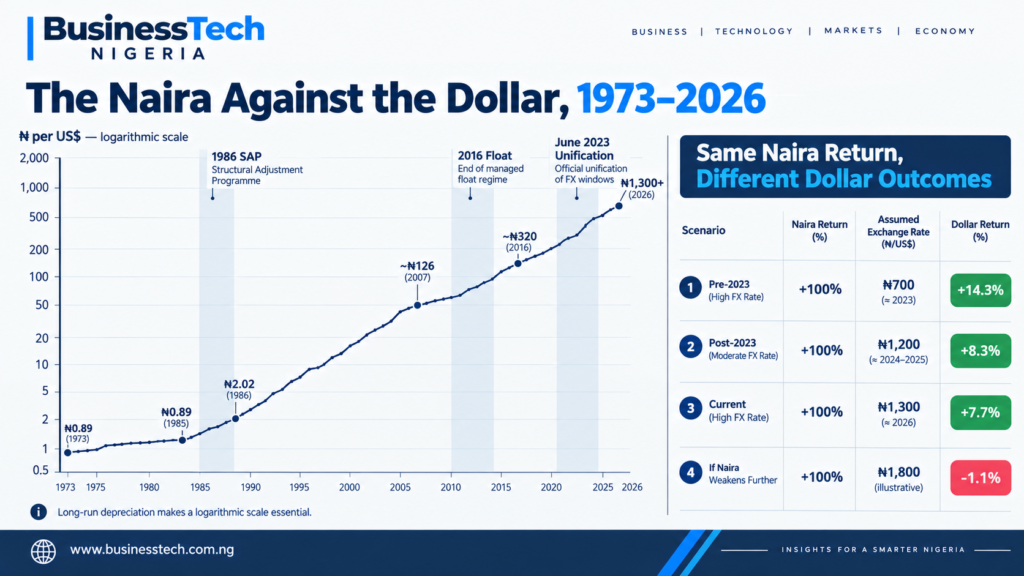
A significant share of demand for this offer is coming from Nigerians living and earning outside Nigeria, in dollars, pounds, and Canadian dollars, drawn by the scale of the asset, the national pride attached to it, and management’s own stated ambition to deliver returns that are meaningful in dollar terms. This section is written specifically for that reader, because the arithmetic that matters to you is different from the arithmetic that matters to a Lagos-based investor, and almost nobody explains the difference clearly.
The core fact is simple to state and easy to underweight emotionally: a naira gain is not a dollar gain. It is a naira gain, multiplied by whatever the naira did against the dollar over the same period, which in Nigeria’s modern history has almost always been negative.
The scale of that historical drag is worth stating plainly, because it has been severe and it has been persistent. The naira has moved from roughly ₦0.89 to the dollar at its introduction in 1973 to over ₦1,300 today, a decline of more than 99.9 per cent of its value over five decades. Confining the comparison to the period relevant to Dangote Sugar’s listing, the official rate moved from roughly ₦125 to ₦130 in March 2007 to a range of ₦1,319 to ₦1,400 by September 2026, depending on which reference point is used, a naira depreciation on the order of 90 per cent, or put the other way, it now takes roughly ten times as many naira to buy one dollar as it did in 2007. Much of that decline was gradual, but a substantial share of it happened suddenly: the June 2023 unification of Nigeria’s exchange rate windows saw the official rate move from around ₦460 to over ₦760 almost overnight, eventually reaching beyond ₦1,500 by early 2024, a shift the Central Bank of Nigeria itself later described, across 2021 to 2023, as an 83.93 per cent cumulative depreciation.
Now apply this to the Dangote Sugar example directly, because it makes the abstract point concrete. In naira, ₦18 becoming ₦72 is a 4-times return. Converted at the approximate 2007 official rate of ₦125 to ₦130, that ₦18 share cost a diaspora investor roughly 14 US cents. Converted at today’s rate of approximately ₦1,319 to ₦1,400, that same ₦72 share is worth roughly 5.1 to 5.5 US cents. The Lagos investor quadrupled their naira. The diaspora investor lost more than half their dollars, on the same shares, held for the same nineteen years.
This is not a criticism of Dangote Sugar’s management, who do not control Nigeria’s monetary policy, and it is not a reason to avoid Nigerian equities altogether. It is a demonstration that the currency of measurement is not a footnote. It is frequently the deciding factor in whether an investment succeeded.
Here is why the calculation is more favourable, though not risk-free, for Dangote Refinery specifically. Unlike Dangote Sugar, a substantial share of the refinery’s revenue is dollar-linked, through direct export sales to Europe and other markets and through dollar-referenced domestic product pricing. Management has stated an intention to generate and potentially distribute returns with reference to dollar value, and the company’s core debt is dollar-denominated against dollar-linked revenue, a matched structure discussed in the debt section of this article. This gives the underlying business more genuine dollar character than a naira-revenue consumer goods company like Dangote Sugar ever had.
But a diaspora investor’s shares still trade in naira on the Nigerian Exchange, and any dividend, unless and until the company demonstrates otherwise in practice, will most plausibly be declared and paid in naira before conversion. The company’s stated dollar-return ambition is an intention, not a contractual guarantee, and the prospectus does not promise a specific dividend amount or currency. This means the diaspora investor’s actual outcome still depends on three separate things happening favourably at once: the naira share price needs to rise, dividends, if any, need to be paid, and the naira needs to hold its value, or at least not collapse, by the time any of that value is converted back into the investor’s home currency.
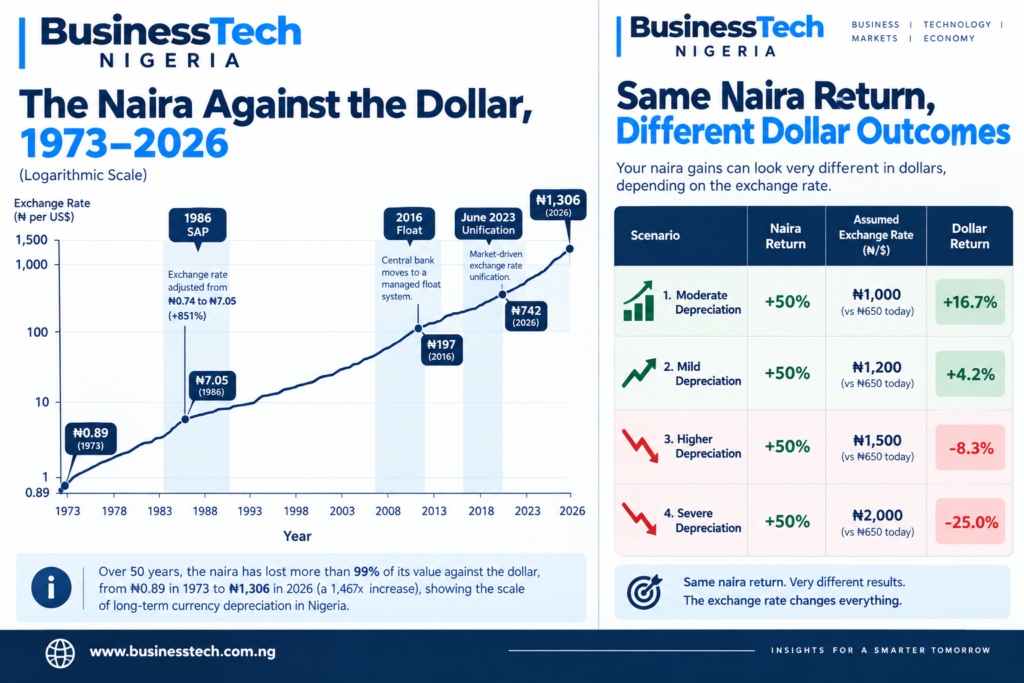
Below is a purely illustrative framework, using clearly labelled hypothetical assumptions, not a forecast and not investment advice, to show how differently the same operational outcome can look in naira and in dollars.
| Scenario | Naira share price in 10 years | Naira return | Naira/dollar rate assumed | Dollar return |
|---|---|---|---|---|
| Naira holds near current level | ₦900 | +71% | ₦1,350 (unchanged) | +71% |
| Naira depreciates at its 10-year historical pace | ₦900 | +71% | ₦2,800 (roughly doubled) | −15% |
| Naira depreciates severely | ₦900 | +71% | ₦4,000 | −39% |
| Strong operational outcome, moderate naira depreciation | ₦1,400 | +167% | ₦2,800 | +33% |
The pattern that should stand out is the third row against the first. It is entirely possible for the share price to perform well by Nigerian standards, in this illustration a 71 per cent gain, and for the diaspora investor to still lose money in dollar terms, purely because of what happened to the currency along the way. This has been the historical norm for naira-denominated assets, not the exception, and Nigeria’s own central bank data on cumulative depreciation across the past two decades supports treating it as the base case a diaspora investor should plan around, rather than a pessimistic tail risk.
None of this means diaspora investors should avoid this offer. It means the return that matters to you is not the naira return quoted in every headline this month. It is the naira return, adjusted for what the naira does against your own currency over your specific holding period, a variable this article cannot predict and no analyst honestly can either. Build your expectations around that adjustment before you commit, not after you discover it.
Heartbreak Insurance: What I May Do
There is a concept worth borrowing from experienced investors everywhere, adapted here for this specific decision, that we will call heartbreak insurance. It is not a trading strategy, and it will not improve your returns. It exists to protect you, financially and psychologically, from the worst version of the outcomes described throughout this article, without requiring you to guess correctly which outcome will occur.
Size the position to what you can genuinely afford to not touch. This is the single most important piece of insurance available, and it costs nothing. Whether you commit ₦5,250 or ₦5 million, the position should be money you will not need for rent, school fees, or an emergency within the timeframe this investment actually requires, which based on everything in this article is measured in years, not months. Money you might need soon has no business in a 3.41 per cent free float, thinly traded, single-country, cyclical industrial stock, regardless of how proud you are of what it represents.
Avoid leverage entirely. Never borrow to buy this, or any single stock. Borrowed money attaches a deadline to a decision that has no natural deadline, forcing you to sell at whatever price prevails when the loan comes due, rather than when the fundamentals justify it. Given how volatile a thin float can be, discussed earlier in this article, that deadline could arrive at exactly the wrong moment.
Keep liquidity elsewhere. With a one-year Treasury bill currently yielding around 16.62 per cent, there is no financial cost, and considerable psychological benefit, to keeping a meaningful share of your savings somewhere boring and liquid while this investment plays out over years. This is not a hedge against Dangote Refinery specifically. It is a hedge against needing to sell any long-term holding at a bad moment because you have nowhere else to turn.
Avoid concentration. However compelling the story, this is one company, in one country, in one cyclical industry, controlled by one family. A position sized as though it were the safest thing you own is a position sized incorrectly, regardless of how large or important the underlying asset is.
Define your holding period and your reason before you buy, not after. Are you buying because you believe the expansion will succeed and margins will normalise gently over five to ten years? Are you buying because you want a small, symbolic stake in a national achievement regardless of return? Are you buying because everyone around you is buying? Only the first two survive contact with a bad quarter. Write your reason down. When the share price does something uncomfortable, and given the thin float and the cyclicality discussed throughout this article, it will, that written reason is what tells you whether the original thesis has changed or whether you are simply frightened.
Distinguish volatility from permanent impairment. A falling share price is not automatically bad news. If it falls because refining margins have normalised as this article expected all along, and the underlying business is performing as you believed it would when you bought it, that is volatility, not loss. If it falls because crude supply has become structurally worse, or because the expansion has overrun by billions of dollars with no clear path to completion, that is a different kind of decline, and a reason to genuinely reassess. Confusing the two, in either direction, is how investors either panic-sell a temporary dip or stubbornly hold through a permanent deterioration.
Do not size your position based on the minimum subscription. As discussed earlier, ₦5,250 was chosen to make the offer accessible, not to signal an appropriate position size. Let your own analysis, not the issuer’s marketing choice, determine how much of this you own.
None of this is exotic. It is the same discipline experienced investors apply to every concentrated position in a cyclical, controlled, thinly-floated company, anywhere in the world. The reason it deserves its own section here is that an offer this large, this patriotic, and this heavily marketed to first-time retail investors is precisely the environment in which ordinary discipline is most likely to be abandoned, and precisely the environment in which abandoning it will hurt the most people.
Figures presented as our own illustrative constructions, clearly labelled in the text as hypothetical and not forecasts: the entire diaspora currency scenario table, the naira and dollar return calculations applied to the Dangote Sugar example, and the approximate 90 per cent naira depreciation figure calculated from the 2007 and 2026 rate ranges cited above. The exact March 2007 daily official rate was not independently pinned to a single verified source and is presented as an approximate range rather than a precise figure.
What Readers and Investors Are Actually Saying
A note before the piece itself: what follows draws on public comments left by readers and viewers across various platforms discussing the Dangote Refinery IPO. These are unverified, self-identified handles rather than named, credentialed sources, and their claims have not been independently checked. They are presented here as a snapshot of public sentiment, not as fact, and are treated with the same caution any responsible publication applies to anonymous online commentary.
Beyond the Headlines: What the Public Is Actually Debating
Every IPO generates official commentary from analysts, issuing houses and the company itself. What it also generates, in far larger volume and often with sharper edges, is the running conversation among ordinary people deciding whether to put their own money in. Reading through that conversation on this offer reveals a public that is considerably more sophisticated, and considerably more divided, than the “people’s IPO” framing suggests.
Six distinct arguments recur often enough to be worth taking seriously, whether or not each one holds up under scrutiny.
The operations sceptic: “Nobody is doing a critical analysis”
One commenter, identifying himself as having ten years of experience in refinery process operations, raised a set of pointed operational questions rather than a financial one. His concern centres on crude sourcing: that Nigeria cannot supply the volumes the refinery needs, forcing reliance on international crude of uncertain type and cost, and that heavy debt sits behind a business whose survival, in his framing, is tied unusually closely to one man. He also referenced ongoing legal friction between the company and the federal government over market dominance.
This overlaps closely with the crude supply constraint examined in detail earlier in this article. The prospectus itself discloses that the Domestic Crude Supply Obligation covers at most half of current capacity and is explicitly conditional, and Nigerian crude receipts have already eased rather than grown through 2026. A reader with direct industry experience arriving independently at the same concern that the prospectus discloses is worth noting, not dismissing as excessive caution. Where this comment goes further than the public record supports is the suggestion that the business is existentially dependent on one individual; the operating company, its debt and its asset base exist independently of any single person, even if governance and strategic direction currently do not.
The diaspora calculation, confirmed from lived experience
A UK-based reader offered direct confirmation of the currency argument made earlier in this article, describing the naira’s “slow and steady downward trend” as a factor that must inform any decision, and noting a personal preference for UK property specifically because of the capital-growth reliability that a stable currency provides. This reader also raised a question this article touched on but did not resolve: the long-term trajectory of demand for petroleum products as energy technology evolves, drawing a deliberate comparison to coal’s decline.
A separate European-based commenter added a specific and often-repeated data point worth flagging rather than confirming: a claim that the North Sea has exhausted roughly 93 per cent of its oil reserves, alongside a broader argument that Europe’s shift toward solar power reduces its usefulness as a long-term customer for African-refined product, positioning the refinery instead as primarily built for African demand. The precise reserve-depletion figure was not independently verified for this article and should be treated as an unconfirmed claim rather than an established fact, though the broader observation, that Europe’s energy transition is a genuine variable in the refinery’s long-term export market, aligns with the demand-side discussion in the bull and bear case sections above.
One reader’s personal history added real weight to the currency warning: an account of a €30,000 investment in Nigeria in 2016 that grew to roughly €42,000 before falling to approximately €8,500, a loss of about 80 per cent from its peak, attributed to a period of currency instability under a change in administration. Whatever the precise details, the shape of that account, a naira-linked position posting strong local gains that were then erased by currency movement, is exactly the mechanism this article’s currency section describes, not as a hypothetical, but as something a reader says happened to their own money.
The long-hold versus the trader: two disciplined but opposite strategies
Two commenters staked out opposite, internally consistent positions on holding period, and both deserve to be taken on their own terms rather than declared right or wrong.
One reader described a buy-and-hold philosophy explicitly built around the currency risk discussed above: a “reliable USD income stream,” referencing management’s stated dollar-dividend ambition, as a structural hedge against naira devaluation, alongside a caution that if the 1.4 million barrel expansion slips past 2029, capital will sit tied up longer before reaching peak profitability. He also raised a fair question about what happens to the current, exceptional margin environment if Middle Eastern supply normalises, a concern this article’s bull-case and bear-case sections addressed directly.
Another reader argued the opposite: that Nigeria’s equity market rewards active trading over buy-and-hold, citing a claimed pattern of six-to-nine-month cycles and an illustrative example of Dangote Sugar’s share price rising from around ₦50 in December 2025 to as high as ₦95.80 in May 2026, a gain of roughly 92 per cent at the peak, before asking why an investor would hold indefinitely rather than take profits and redeploy. This is a legitimate trading strategy for investors with the time, skill and risk tolerance to execute it, though it is worth noting explicitly that a compounding illustration built on a claimed 30 per cent average annual return is a best-case demonstration of arithmetic, not a track record, and past six-to-nine-month price swings in one stock do not guarantee that the same pattern repeats in a newly listed, thinly floated company with no independent trading history of its own.
The insider-pricing objection
A pointed comment argued that early, well-connected buyers at pre-IPO prices will sell into demand from retail investors buying at and after listing, comparing the structure to a pyramid in which insiders profit at the expense of “the masses,” and suggesting that a genuine wealth-sharing intent would have opened the earlier, cheaper rounds to everyone.
This article’s earlier section on why an IPO does not mean getting in early addressed the mechanics behind this concern directly: the July private placement priced the same equity meaningfully below the public offer, and institutions with far greater negotiating power and information access were compensated for earlier risk with better terms. Whether that structure amounts to unfairness or simply reflects the normal, universal mechanics of how private and public capital markets are sequenced everywhere in the world is a matter of perspective rather than fact. What is factual, and worth restating plainly, is that the retail public is not buying at a discount to informed money. It is buying after informed money has already been paid for taking the earlier risk.
The geopolitical wildcard
One comment raised a risk this article did not directly address: the possibility that established global oil interests, or geopolitical actors more broadly, could have an interest in disrupting the refinery’s expansion or operations, given the scale of the challenge it poses to established supply patterns. His recommendation was to wait for the expansion to be substantially realised, and for profits, dividends and earnings per share to be demonstrated over time, before investing.
The specific mechanism described is speculative and not something this article can verify or meaningfully assess. But the underlying caution, that a project of this geopolitical significance carries risks beyond the purely commercial ones catalogued earlier in this article, from crude markets to construction execution, is a reasonable addition to the risk register, even if the precise channel through which such risk might materialise cannot be specified with confidence.
The blunt sceptics
A cluster of comments rejected the investment case more simply. One reader listed five reasons for declining to subscribe: an offer size he considered excessive relative to the company’s realistic needs, the underlying volatility of the refining business, the scale of the expansion cost, currency exposure, and a comparison of likely returns against available alternatives, concluding the offer was simply less attractive than other options. Another argued more sharply that the business model exists primarily to access low-cost public capital rather than to generate returns for shareholders, without any real accountability for the debt burden that results. A third invoked Transcorp, another heavily promoted Nigerian listing, as a cautionary comparison, and stated a preference for investments the commenter understands and controls directly, with returns that are measurable and dependable.
None of these three comments offers new factual information beyond what this article has already examined. What they offer is a useful corrective to any assumption that scepticism about this offer is confined to financial analysts. A meaningful share of ordinary Nigerian and diaspora investors, weighing the same public information everyone else has access to, are independently arriving at a similar conclusion to the more cautious analysis in this article: that ₦525 asks a great deal of the future, and that “a great business” and “a great investment” are, once again, two different questions.
What This Tells Us
Reading through this conversation alongside the formal analyst coverage produces one clear observation. The most substantive objections circulating among ordinary readers, crude supply constraints, currency erosion, the pricing gap between private and public rounds, and expansion execution risk, are not fringe concerns invented by contrarians. They are the same concerns this article has spent seven batches examining against the company’s own prospectus. The public conversation, messy and unverified as parts of it are, has largely converged on the right questions. What it has not converged on, and what no single article or comment thread can resolve in advance, is the answer.
Research Notes / Sources Used
This piece draws exclusively on reader and viewer comments supplied for this article. These are anonymous or pseudonymous online contributions, not independently verified sources, and specific factual claims within them, including the North Sea reserve depletion figure, the precise mechanics of the 2016 currency loss described, and the claimed NGX six-to-nine month trading cycle, have not been independently confirmed and are flagged as such in the text. Where comments overlap with claims examined earlier in this article using primary sources, cross-references are noted rather than re-cited in full.
What ₦525 Asks of You
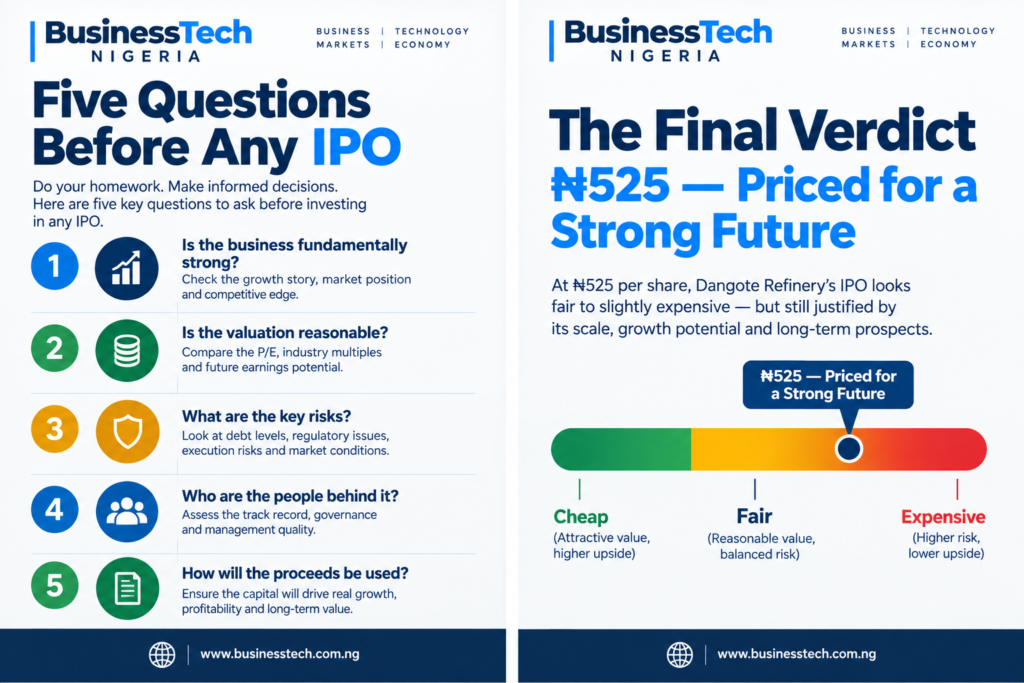
Seven batches and one reader roundup later, the essential question of this entire analysis has not moved. It is the same question it was in the opening line: not whether Dangote Refinery is a remarkable business, but what its future would have to look like for ₦525 to have been a good price.
The evidence assembled here does not resolve that question, because no honest analysis of a business this young, this cyclical, and this early in a decade-long expansion ever could. What the evidence does is narrow the question to something you can actually answer for yourself.
You now know that ₦65.22 trillion prices the shares at roughly 13 times a first-half profit earned during the most favourable refining margins the global industry has seen in years, against a domestic risk-free alternative paying nearly as much with none of the risk. You know that the crude the expansion needs is not guaranteed, that the debt is currently well-structured but will grow before it shrinks, and that the free float is thin enough to make the shares volatile regardless of how the underlying business performs. You know that early institutional buyers were paid a better price for taking earlier risk, that the currency you eventually measure your return in matters as much as the return itself, and that a great operational outcome can still be a mediocre investment if the price already assumed it. The readers whose comments closed out this piece independently reached several of the same conclusions from their own experience, which is itself worth something: this is not a niche concern invented by sceptical analysts, but a live, widely shared set of questions among the very people this offer was designed to reach.
None of that is a verdict. It is the material a verdict requires.
If you subscribe, do it because you have done the arithmetic in the section on the real number, not because ₦5,250 felt too small to think about. Size the position to what you can leave alone for years, keep your expectations honest about what the naira has done to naira-denominated wealth for two decades running, and hold the six conditions this article laid out in view, because your outcome depends on all of them, not on the story alone. If you decide not to subscribe, that is not scepticism for its own sake. It is simply a judgement that, at this specific price, the future being asked of you is more demanding than the future you can find elsewhere.
Dangote Refinery did not need this article to prove it is an extraordinary industrial achievement. It has already proven that, in steel, in barrels, in the jet fuel now leaving Lekki for Rotterdam. What it has not yet proven, because no company can prove such a thing in advance, is that ₦525 was the right price to pay for what comes next.
That is the only question that was ever going to determine whether this was a good investment. Everything else was the story. This was the arithmetic. Both mattered. Only one of them decides your return.
Frequently Asked Questions: The Dangote Refinery IPO
A companion FAQ to the full analysis, for quick reference. Where a figure is disclosed in the prospectus or by the company, it is presented as fact. Where a figure is our own calculation or a scenario, it is labelled as such.
The Offer Itself
What is actually being sold in this IPO?
4.1 billion new ordinary shares in Dangote Petroleum Refinery and Petrochemicals FZE, the company that owns and operates the refinery at Ibeju-Lekki. It is not shares in Dangote Cement, Dangote Sugar, or Dangote Industries Limited. Those remain separate, already-listed or privately held companies.
What is the share price and the minimum investment?
₦525 per share, with a minimum application of 10 shares, or ₦5,250.
When does the offer open and close, and when will shares list?
The offer opened on 14 September 2026 and closes on 13 October 2026. Shares are expected to begin trading on the Nigerian Exchange in November 2026.
How much is the company trying to raise, and how big is the company overall?
The base offer could raise approximately ₦2.15 trillion (about $1.6 billion). At the offer price, with 120.13 billion existing shares plus the new issue, the implied post-offer equity value is approximately ₦65.22 trillion (roughly $47 billion to $49 billion, depending on the exchange rate applied).
What percentage of the company is actually being sold?
Roughly 3.41 per cent of total shares. Aliko Dangote holds about 92.3 per cent before the offer, diluting to roughly 89.25 per cent afterward. This is one of the smallest free floats of any major IPO globally.
Is there a greenshoe option?
Yes. Reports indicate a greenshoe of up to 30 per cent could allow the company to sell additional shares if demand exceeds the base offer, subject to approvals. If fully exercised, total proceeds could rise toward roughly ₦2.8 trillion.
Who can buy, and how?
Nigerian and other eligible investors can apply through banks, licensed stockbrokers, approved fintech platforms, and NGX Invest, as named in the official prospectus and offer channels. Always verify that any platform or intermediary is listed in the official, SEC-cleared documents before sending money or personal details.
The Valuation
Is ₦525 cheap or expensive?
There is no single correct answer, because it depends entirely on what you believe the company’s sustainable, normalised annual profit will be. At an annualised first-half 2026 profit of roughly $3.64 billion, the offer values the company at about 13 times earnings, which is not obviously expensive. If margins normalise toward more typical historical levels, the effective multiple on sustainable earnings rises considerably, which would make the price look expensive in hindsight. This is the central, unresolved question of the entire investment case.
Why does the number of shares matter so much?
Because it determines what a given price actually represents. Dangote Refinery has roughly 124 billion shares after the offer, far more than most listed Nigerian companies, which is why a company worth ₦65.22 trillion, the largest valuation ever proposed on the Nigerian Exchange, can be entered for ₦5,250. A low unit price makes an offer accessible; it does not make the underlying company cheap.
How does this compare to global refining companies?
At an estimated enterprise value to EBITDA of roughly 9.7 times on peak-cycle earnings, Dangote Refinery is priced at a premium to most listed global refiners. Valero traded around 8.2 times trailing EV/EBITDA in September 2026, Marathon Petroleum around 9.1 times, and the broader industry average was cited around 5.8 times. Only Phillips 66, at around 11.6 times, sat clearly above Dangote’s implied multiple.
Why did earlier investors pay less?
In July 2026, a private placement priced the same equity at roughly $0.35 per share, implying a valuation of about $40 billion, versus $0.40 per share and roughly $47 to $49 billion at the public offer. Institutions such as Africa Finance Corporation accepted a 365-day lock-up in exchange for the lower price. The public is paying a premium of roughly 14 to 17.5 per cent above that placement, with no lock-up, seven weeks later.
Does buying at the IPO mean getting in early?
No. The refinery began commercial operation in February 2024. By the time retail shares are allotted, the plant will have operated for close to three years, moved through construction and commissioning risk, and already been valued through at least five prior financing events involving Afreximbank, Access Bank, NNPC, and Africa Finance Corporation. Retail investors are buying after the highest-risk phase has passed and after informed capital has already been compensated for taking that risk.
The Business and Its Financials
Is the company actually profitable?
Yes, as of the first half of 2026. The company reported a profit after tax of approximately ₦2.50 trillion (about $1.82 billion) for the six months to 30 June 2026, reversing a loss of ₦723 billion (about $476 million) for the full year 2025, and a loss of roughly $1.51 billion in 2024. Combined losses across 2024 and 2025 were approximately $1.99 billion.
What caused the swing from losses to profit?
Three factors: rising utilisation as the plant matured operationally (the most durable driver), a sharp increase in global refining margins from $13.70 per barrel in 2025 to $24.50 in the first half of 2026 (the least durable driver, driven substantially by global geopolitical disruption), and the disappearance of one-off commissioning costs that depressed the 2024 and 2025 results.
Are these margins normal, or unusually high?
Unusually high. Global refining margins across the industry roughly tripled during 2026, driven largely by supply disruption linked to the conflict in the Middle East. Forward markets were already pricing significantly lower margins for 2027 at the time of the offer, and the ten-year historical average crack spread sat well below 2026 levels. A responsible investor should not assume these margins persist.
How much capacity does the refinery have, and how much is it actually using?
Nameplate capacity is approximately 700,000 barrels per day, up from an original 650,000. Average utilisation in the first half of 2026 was 83.6 per cent, meaning there is still room to grow output without any new construction.
Where does the crude oil come from?
A mix of domestic Nigerian crude, capped at up to 350,000 barrels per day under the Domestic Crude Supply Obligation framework (and explicitly subject to availability), and international sources including US WTI Midland and crude from South America and the Middle East. The refinery had processed 36 different crude grades as of June 2026.
Is crude supply guaranteed?
No. The prospectus itself states that having multiple supply arrangements does not guarantee uninterrupted crude supply. Nigerian crude receipts have recently eased rather than grown, from around 650,000 barrels per day in May 2026 to 575,000 in June, which is a concern given the company’s plans to double capacity.
The Expansion
What is the expansion plan?
A second crude distillation unit, construction of which began in January 2026, intended to add roughly another 700,000 barrels per day and take total capacity toward 1.4 million barrels per day, potentially making it the largest single refining complex in the world.
How much will it cost, and when will it be finished?
The total programme is estimated at $14.3 billion. Disclosed capital expenditure through the near term is $4.8 billion for the remainder of 2026, $3.9 billion in 2027, and $3.1 billion in 2028. Completion has been described variously across company statements as targeting 2028 or 2029, with the prospectus framing full doubling as a 2030 objective.
How is it being financed?
Through a mix of sources: a $4 billion syndicated term loan arranged in March 2026 (with Afreximbank underwriting $2.5 billion), a $2.5 billion private placement in July 2026, a further $1 billion underwriting programme in August, and now the public offer. This is a more diversified financing structure than the company relied on during its original construction phase.
Will the expansion definitely create value for shareholders?
Not necessarily, and this is genuinely unknowable in advance. Growth only creates shareholder value if the return earned on the additional capital exceeds its cost. That depends almost entirely on two things nobody can currently predict with confidence: what refining margins will average once the new capacity comes online, and whether enough crude can be secured to run it at a reasonable utilisation rate. Size and value are not the same thing.
Debt
How much debt does the company have?
Total secured debt was $5.67 billion as of 30 June 2026, down from $6.24 billion at the end of 2025.
Is this level of debt dangerous?
Based on currently disclosed figures, no. The net debt to EBITDA ratio is approximately 0.27 times, a conservative level by industrial standards, and the debt is dollar-denominated against substantially dollar-linked revenue, which is a prudent, matched currency structure. The company also held more than $4 billion in cash at the same date.
Could that change?
Yes. The comfortable ratio reflects a snapshot taken during an unusually favourable margin cycle. If earnings normalise downward, as this analysis expects to some degree, the same debt level would represent a higher leverage ratio. The company will also take on further, currently undetermined debt to fund the remaining expansion tranches.
Dividends and Returns
Will the company pay dividends?
There is no guarantee. The prospectus states dividends will be paid only if and when declared by the board and approved by shareholders, subject to profitability, cash flow and regulation. Management has expressed an intention to eventually pay dividends with reference to dollar value, but this is a stated intention, not a contractual commitment.
Should I expect dividends soon?
Probably not significant ones in the near term. Operating cash flow in the first half of 2026 was roughly $1.27 billion (₦1.751 trillion), against planned capital expenditure of $11.8 billion over the following two and a half years. Free cash flow is likely to remain negative for several years while the expansion is funded, which limits the cash realistically available for dividends regardless of reported profit.
What is CardinalStone’s target price, and should I rely on it?
CardinalStone has published a 12-month target of ₦688.09, implying roughly 31 per cent capital appreciation plus an estimated 8.5 per cent dividend yield. Chapel Hill Denham has estimated a higher fair value still. Both are above the offer price. It is worth noting that CardinalStone is also one of the joint issuing houses on this transaction, though it states its analysts’ views were independently determined. Treat any published target price during an offer period as one input, not a neutral verdict, since no research published during a live offer has concluded the offer is overpriced.
Currency and Diaspora Investors
Does a rising naira share price mean I made money?
Only if you measure your return in naira. If you earn and spend in dollars, pounds, or another foreign currency, your actual return also depends on what the naira did against your currency over your holding period. The naira has depreciated substantially over the past two decades, and applying that history to Dangote Sugar’s roughly 4-times naira return since 2007 turns it into an estimated loss of more than half in dollar terms over the same period.
Is Dangote Refinery’s currency exposure different from Dangote Sugar’s?
Yes, in a meaningfully better way. Dangote Sugar imports a dollar-priced raw material to sell into naira-priced domestic demand, a poor currency match. Dangote Refinery sells a substantial share of its output into dollar-linked export markets and holds dollar-denominated debt against dollar-linked revenue, a better-matched structure. This does not eliminate currency risk for a shareholder whose shares trade in naira and whose dividend, if paid, will likely be declared in naira before conversion.
Should diaspora investors avoid this offer because of currency risk?
Not necessarily, but they should build their return expectations around naira depreciation as the probable base case rather than a worst case, based on Nigeria’s historical pattern, and should not assume a strong naira share price automatically means a strong return once converted home.
Risks
What are the biggest risks to this investment?
In roughly descending order of how much they could affect returns: refining margins normalising lower than current levels; crude supply failing to keep pace with the doubling of capacity; cost overruns or delays on the expansion; the free zone tax benefit becoming less favourable as domestic sales grow, with profits from domestic sales potentially becoming taxable from 1 January 2028; naira depreciation eroding returns for anyone measuring in a foreign currency; and the very small free float producing volatile trading that may have little to do with the underlying business.
What about governance, given how much control the founder retains?
With roughly 89.25 per cent ownership retained after the offer, minority shareholders will have essentially no influence over capital allocation, dividend timing, or related-party transactions with other Dangote Group entities, including the company’s planned refinery project in Kenya. Nothing in the public record suggests current mistreatment of minority shareholders, but this structure requires a high degree of long-term trust in governance quality.
Is this comparable to other heavily hyped Nigerian listings that disappointed investors?
That comparison has been raised by market commentators, and it is a fair caution to hold in mind. Whether it applies here depends on factors this analysis has tried to make explicit: the strength of the underlying business (genuinely strong, evidenced by real operating results), and the price being asked for it (a separate and still-open question).
Practical Questions
How do I know the offer channel I’m using is legitimate?
Only use subscription channels named in the official, SEC-approved prospectus or the company’s official IPO portal. Never share a PIN, password, or one-time passcode with anyone claiming to process your application on your behalf. Confirm any stockbroker or intermediary is licensed by Nigeria’s SEC.
What happens if the offer is oversubscribed?
Applicants may receive fewer shares than requested, allotted on a basis to be confirmed in the final offer documents.
Should I apply for the minimum, or more?
That should be determined by your own analysis and risk tolerance, not by the minimum subscription amount, which was set to maximise accessibility rather than to signal an appropriate position size for any individual investor.
Is this financial advice?
No. This FAQ and the underlying analysis are for informational and educational purposes only. Figures are drawn from the company’s prospectus and reputable financial reporting, cited in full in the original article’s research notes. Scenario calculations are the author’s own, clearly labelled, and are not forecasts. Readers should read the final prospectus in full and consult a licensed financial adviser before making any investment decision.
References
In preparing this analysis, the BusinessTech Nigeria research team drew on a wide range of primary disclosures, company statements, financial data providers and reputable business press, rather than any single source. What follows traces that research trail in narrative form.
The starting point for every hard number in this piece was the company’s own IPO prospectus summary, hosted via AfricanFinancials, which supplied the offer structure, half-year 2026 financials, total assets and net debt figures that anchor the entire valuation discussion. That was read alongside Nairametrics’ overview of the offer and its later report on the ₦1.5 trillion committed within the first hour of subscription, Billionaires Africa’s coverage of the share count and ownership dilution, and Channels Television’s report confirming the offer price and size. THISDAY’s numbers, carried via allAfrica, and Technext’s breakdown of the prospectus were used to cross-check figures against the prospectus and to flag the exchange-rate discrepancy discussed in the text. Daba Finance’s IPO tracker and Semafor’s report on the August underwriting programme filled in the private financing history that preceded the public offer, while a further allAfrica report supplied context on the SEC approval terms and the broader financing plan.
For the valuation debate specifically, the team relied on Parrot Nigeria’s comparison of the CardinalStone and Chapel Hill Denham estimates against the prospectus figures, Cowrywise’s explainer on the offer, which usefully disclosed CardinalStone’s dual role as both analyst and issuing house, and CED Magazine’s detailed breakdown of the free float and the pricing step-up from the July placement. Global refiner multiples used for comparison came from Zacks’ coverage via Yahoo Finance, GuruFocus’s EV/EBITDA data for Marathon Petroleum, and a further Zacks comparison of Marathon and Valero via TradingView, while the broader argument about cyclical refining margins and their historical volatility leaned heavily on CNBC’s reporting on the 2026 refiner rally and its likely limits.
On operations and the crude supply question, Premium Times’ reporting, carried via allAfrica, on the crude constraints facing the planned 1.4 million barrel expansion was essential, as were two dispatches from OilPrice.com: one on the ground-breaking of the second crude distillation unit and another on the de-bottlenecking that took the plant from 650,000 to 700,000 barrels per day, alongside the shifting crude receipt volumes. Arbiterz’s report on the October crude supply programme and Discovery Alert’s detailed margin and utilisation figures rounded out the operational picture, alongside Streamlinefeed’s citation of Bloomberg and Reuters reporting on the prospectus’s debt and capital expenditure schedule.
The debt and financing narrative was built from Afreximbank’s own press release on the $2.5 billion underwritten term loan, corroborated by African Business’s coverage of the same facility and CNBC Africa’s report via Reuters. Africa Finance Corporation’s shift from lender to equity holder was drawn from Serrari Group’s reporting, while NNPC’s financing arrangement and stated ambitions around its equity stake came from Kolaking’s Substack analysis, a related piece on SBM Intelligence’s Substack, and a further allAfrica report on NNPC’s stake ambitions.
For the longer-horizon demand picture that underpins the bull and bear cases, the team turned to the African Energy Chamber’s 2026 outlook, carried via Ghana Upstream, the Chamber’s own analysis of surging demand for refined products through 2050, Verified Market Research’s projections on African vehicle ownership and urbanisation, and The Guardian Nigeria’s reporting on the country’s continuing petrol import dependence, which also supplied the OPEC estimate of Africa’s refining investment gap. Market-sizing detail on the refined products and electric vehicle markets came from two separate Research and Markets reports, alongside MarkWide Research’s analysis of vehicle fuel preferences across Nigeria and Kenya.
Finally, the currency history that runs through the diaspora section was reconstructed from the Central Bank of Nigeria’s own exchange rate policy documentation, cross-checked against three independent historical accounts: NaijaHub’s timeline of the naira’s decline, AbokiForex’s guide to the currency’s history since 1960, and NairaRateToday’s record from the currency’s 1973 introduction to the present, supplemented by current-rate data from The Global Economy and Investing.com. Nigerian Treasury bill and policy rate figures used as the risk-free comparison throughout the piece came from Nairametrics’ auction reporting, Rio Times’ coverage of secondary market yields, and Trading Economics’ data on the Monetary Policy Rate, while share price and dividend history for Dangote Sugar Refinery, cited throughout the historical comparison sections, came from Mansa Markets, StockAnalysis, and the Institute of Developing Economies’ company file on the firm’s 2007 listing.
A handful of additional sources rounded out specific claims: Leadership’s report on the Facts Behind the Offer presentation, Papers.com.ng’s summary of management’s stated dollar-return intentions, Kudi Compass’s reporting on the pre-offer repositioning in Nigerian equities, BusinessDay’s analysis of the offer against Africa’s capacity to fund itself, Bamboo’s guide to the prospectus risk factors and free zone tax conditions, and dmarketforces’ report on the half-year results.
Where figures from these sources conflicted, as with the exchange rate applied to naira results or the precise completion date given for the expansion, the discrepancy has been noted in the body of the analysis rather than silently resolved. Reader and viewer comments referenced in the accompanying reader-roundup piece were sourced separately, are unverified, and are treated throughout as public sentiment rather than fact.