|
Getting your Trinity Audio player ready...
|
The Nigerian Browser Game That Turned Lagos Itself Into a Million-Player Hit
A week ago, almost nobody outside a small circle of Nigerian tech Twitter had heard of Lagos Life. By the end of that same week, more than a million people had created a character, rented a room, and started paying virtual rent every Saturday in a browser game built entirely around the rhythms of one city.
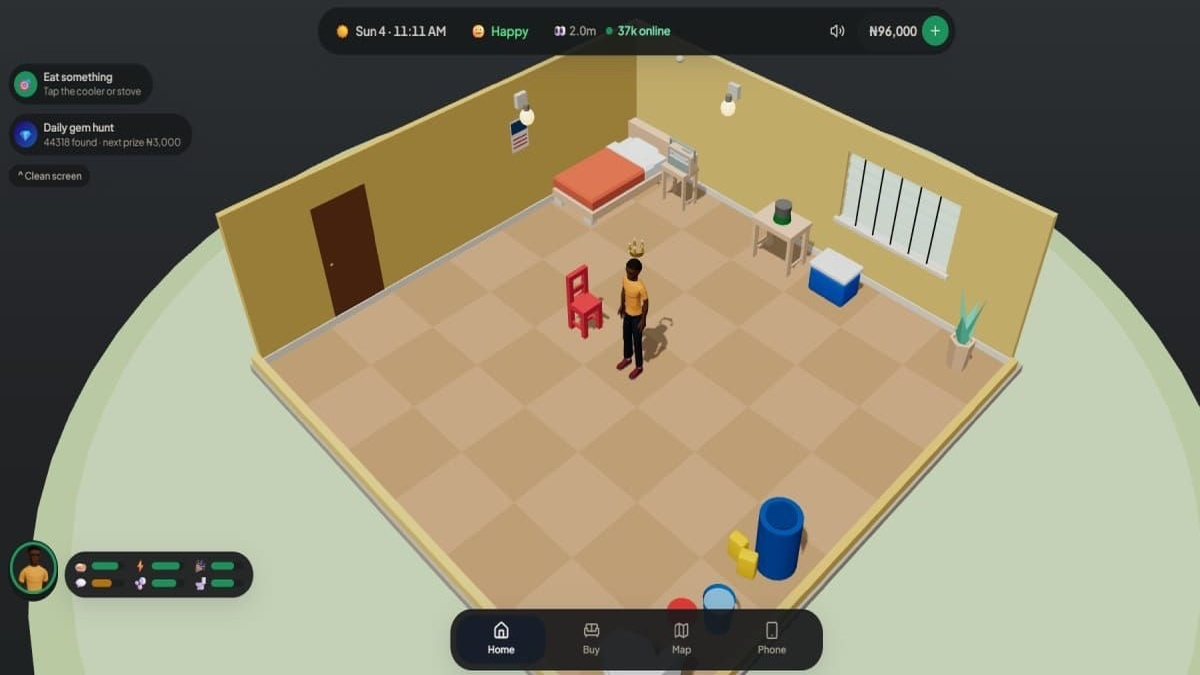
The game is the work of a single developer, Shalom Rayhamen, who posted about the project on X on October 1. The premise is simple enough to explain in a sentence: what if The Sims, the decades-old life simulation franchise, had been built from scratch around Lagos rather than a generic American suburb. Players create a virtual character, find work, earn and spend money, build relationships with other real players, and move through a world stitched together from places Lagosians actually recognize, including nightlife spots like Quilox and food stalls like Amala Shitta. There’s nothing to download. The whole thing runs directly in a browser on Safari or Chrome, on a phone or a laptop, which turned out to be central to how fast it spread.
The growth curve is the kind startup founders usually only dream about. Within two days the game had crossed 100,000 players with more than 11,000 people online simultaneously. By day four it had passed 50,000 concurrent users and Rayhamen had already announced Abuja and Port Harcourt versions were coming. By October 4, roughly three to four days after launch depending on how you count it, Lagos Life crossed one million total players, with more than 109,000 people logged in at the exact moment that milestone was hit. As of the most recent snapshot, the game was adding close to 890,000 new players a day, a pace that would be remarkable for a funded app studio, let alone a single developer’s browser project.
What’s made the game spread so quickly isn’t really the mechanics, which borrow heavily and openly from The Sims. It’s the texture. Players don’t just get a generic job and a generic apartment, they start life in Lagos Life through what’s become known online as the birth lottery, landing either as a wealthy, well-connected Nepo Baby or as a Lapo Baby, a nod to LAPO Microfinance Bank and the kind of debt-funded start many Nigerians recognize instantly. That single detail has become one of the game’s most screenshotted, most argued-about features, exactly the kind of inside joke that makes a Nigerian user feel like the game was built specifically for them rather than adapted from somewhere else. Beyond the opening lottery, players pay rent every Saturday to a figure the game calls Baba Landlord, haggle with in-game danfo and okada fares, and even vote in a weekly governor election that plays out across the entire shared city at once.
Rayhamen has kept adding to the social layer since launch. Players can now hold real in-game weddings, have babies together, and add other users as siblings, cousins or aunties, turning the game from a solo hustle simulator into something closer to a shared soap opera that thousands of strangers are writing together in real time. That shared-world structure is also where the game’s now-famous money culture comes from. Players routinely hand out massive in-game cash gifts to followers, joking that a billion naira in Lagos Life is worth about as much as one real naira, a bit that’s become a running gag across the platform even as it fuels more sign-ups from people chasing a piece of the virtual windfall.
Unlike a lot of viral Nigerian apps that have come before it, Lagos Life didn’t wait to figure out how to make money. The game sells advertising directly inside its fictional city through virtual billboards, and the process is almost comically frictionless: no account needed, an advertiser simply uploads a logo, pays, and the ad goes live inside the game world. Musicians have reportedly been offered the chance to pay around ₦50,000 to get their songs played in the game’s virtual clubs, raves and other hangout spots, turning the simulation into a genuine, if small, promotional channel for real artists trying to reach a captive, culturally tuned-in audience.
The project hasn’t been without hiccups. A brief outage on October 2 knocked the game offline just as it was picking up momentum, and Rayhamen responded by crediting every player with ₦100,000 in virtual cash as an apology, a move that, if anything, seemed to deepen goodwill rather than dent it. Success has also bred imitators almost immediately. A separate browser game called Road to Number One, built around moving to Lagos and chasing music stardom, launched after its own creator saw both Lagos Life and an earlier danfo-themed game making the rounds. Another title, Lagos Run, has emerged as a rival with a notably different approach, carrying no advertising at all.
It’s worth being clear-eyed about one thing: every player count and engagement figure attached to Lagos Life so far comes directly from the game’s own internal dashboard rather than any independent tracking service, which means the headline numbers, impressive as they are, haven’t been verified by an outside source. That distinction matters for anyone trying to judge whether Lagos Life represents a durable platform or simply a spectacular, short-lived viral moment. Hosting costs, content moderation across a million-plus users, payment processing for its advertising model, and whether players actually keep coming back once the initial novelty fades are all still open questions. For now, though, Lagos Life has already proven something that’s genuinely difficult to fake: given a product built specifically around their own city, their own slang and their own daily hustle, more than a million Nigerians showed up within days, no app store required.