|
Getting your Trinity Audio player ready...
|
Last updated: September 28, 2026
Summary: Python Leads, But Combinations Pay More Than Single Skills
Unlike inflation or exchange rates, there is no single Nigerian government agency that tracks programming language demand, so this analysis combines global hiring data with Nigeria-specific job market reporting. The clearest findings:
- Python is the most in-demand language globally in 2026, sought by about 45.7% of recruiters, ahead of JavaScript at 41.5% and Java at 39.5%, according to Itransition’s developer-survey analysis.
- In Nigeria specifically, JavaScript and Node.js remain the most requested hire, alongside growing demand for Python in data-adjacent roles, according to a 2026 Nigerian developer market guide.
- Skill combinations, not single languages, drive the highest Nigerian salaries. Python plus machine learning plus SQL, and JavaScript plus React plus Node.js, are cited as the two most valuable stacks locally.
- DevOps, cloud and cybersecurity specialists are in short supply relative to demand in the Nigerian market, which pushes up pay for people with those skills.
- Nigerian machine learning engineers with strong skills can earn ₦1 million to ₦3 million a month, according to one Nigeria-focused skills guide, well above typical software developer pay.
This first part covers the global demand data, what it means translated to the Nigerian market, and the specific languages and combinations Nigerian employers are hiring for. The second part covers non-coding tech skills, learning pathways, sector-by-sector demand, salary implications, and the outlook for 2027.
A Note on the Data
Programming language demand is measured through job postings, developer surveys and recruiter behaviour, not official labour statistics, so figures vary by source and methodology. Most large-scale studies, including Stack Overflow’s Developer Survey and Itransition’s recruiter analysis, are global or US-focused. Nigeria-specific reporting exists but draws on smaller samples, such as job board scans and community observation, rather than nationally representative data. Where a figure is global, this article says so explicitly, and readers should treat Nigeria-specific claims as directional rather than statistically precise.
Global Demand: What the Data Shows
| Language | Recruiter demand (global) | Main use case |
|---|---|---|
| Python | About 45.7% of recruiters actively seeking Python developers | AI, machine learning, data science, automation, backend |
| JavaScript | About 41.5% | Web development, full-stack, frontend and backend via Node.js |
| Java | About 39.5% | Enterprise systems, large-scale backend applications |
| SQL | Ranks in the top five by employer demand in most 2026 analyses | Data querying, business intelligence, reporting |
| Go | Growing steadily | Cloud infrastructure, DevOps, systems programming |
| TypeScript | Became the top language on GitHub by contributor count in 2025 | Typed JavaScript for large-scale web applications |
Source: Itransition developer-survey analysis, BridgeView IT 2026 job market analysis, Stack Overflow Developer Survey 2025 data as reported by TechDailyCare.
Why Python Is Pulling Ahead
Python’s rise is tied almost entirely to artificial intelligence and machine learning. One 2026 analysis found Python adoption jumped 7 percentage points year-over-year, the largest single-year gain for any major language, driven by AI work. Virtually every major AI framework, including TensorFlow, PyTorch and Hugging Face, is Python-native, which means the language benefits directly from the broader AI investment boom happening across the tech industry.
JavaScript’s Staying Power
JavaScript is not losing ground so much as sharing it. It still runs in every major browser and pairs with frameworks such as React, Angular and Node.js to power both frontend and backend development. Its continued dominance in web development, combined with TypeScript’s rise as a safer, typed version of the same language, means the JavaScript ecosystem as a whole remains central to hiring.
What This Looks Like in the Nigerian Market
A 2026 developer market guide focused on Nigeria, drawing on observation of Nigerian developer communities and hiring patterns, offers a more grounded picture of local demand:
| Role type | Nigerian demand signal |
|---|---|
| Full-stack and backend developers | Most requested technical hires, especially JavaScript and Node.js |
| Data-adjacent roles | Increasingly asking for Python |
| DevOps and cloud specialists | In short supply relative to demand |
| Data analysts and business intelligence | Grown quickly, driven by fintech and banking’s need to turn transaction data into decisions |
| Cybersecurity | Still under-resourced almost everywhere in the market |
Source: TalentExAfrica market guide, August 2026, as republished on DEV Community.
The Pattern: Local Employers Chase Scarcity
The Nigerian pattern echoes the global one but with a local twist. Fintech and banking, Nigeria’s largest tech-adjacent employers, need people who can extract insight from transaction data, which explains why data analyst and business intelligence roles have grown quickly. Meanwhile, the shortage in DevOps, cloud and cybersecurity is not unique to Nigeria, but it is more acute here because fewer local training pathways exist for these specialisations compared with general web development bootcamps.
The Skill Combinations That Pay Best in Nigeria
According to a 2026 Nigerian tech skills guide, single-language expertise is less valuable in the local market than a recognised combination of skills tied to a specific career path.
| Combination | Career path | Where it is used |
|---|---|---|
| SQL + Python + Power BI | Full data analyst stack | Fintech, banking |
| Python + Machine Learning + SQL | Data scientist stack | Fintech, health tech, AgTech |
| JavaScript + React + Node.js | Full-stack web developer | Startups and freelance work |
| Power BI + Excel + SQL | Business analyst | Banking, consulting, NGOs |
| Cybersecurity + Networking (CCNA) | Security specialist | Banks, telecoms, government agencies |
The guide notes that Nigerian banks, consulting firms, government agencies and NGOs all rely heavily on Power BI for reporting, making it one of the fastest skills to learn relative to the doors it opens, since it typically takes far less time to become competent in than a full programming language. Machine learning is now listed at scale in Nigerian fintech, health tech and agricultural technology job postings, with the guide citing pay of ₦1 million to ₦3 million a month for experienced machine learning engineers, well above the general software engineer benchmarks covered in our related salary analysis.
Non-Coding Tech Skills in Demand in Nigeria
Not every well-paid tech role requires programming. A December 2025 BusinessDay analysis of the skills Nigerians need in 2026 pointed to several non-coding paths gaining ground alongside the traditional developer track.
| Skill area | Why it is rising | Nigerian salary indicator |
|---|---|---|
| UI/UX and product design | Fintechs, health tech and e-commerce all need conversion-focused interfaces | Entry-level ₦120,000 to ₦300,000; senior ₦500,000 and above |
| Product management | Bridges business strategy and engineering teams | Cited among the fastest-growing professional roles globally |
| Digital marketing and growth analytics | Businesses compete for online attention across social media and search | Lower barrier to entry than coding roles |
| Prompt engineering and AI workflow design | A genuinely new field with less saturation than established tech roles | Described as a less saturated, emerging market in Nigeria |
| Cybersecurity | Businesses moving online need protection for data and financial systems | Consistently cited as under-resourced in the Nigerian market |
Source: BusinessDay (December 2025), Sonibaze digital skills guide (May 2026), Profolio UI/UX hiring guide (March 2026).
Prompt Engineering: A Genuinely New Category
Globally, LinkedIn data showed a 250% increase in job postings related to prompt engineering in a single year through 2025, and that trend has continued into 2026 as more industries integrate AI tools into daily work. Importantly, prompt engineering rarely appears in Nigeria, or globally, as a pure standalone job title. It shows up embedded inside other roles: a marketing content strategist who can extract on-brand copy from AI tools, or a UX writer who also optimises the prompts driving an app’s AI assistant. For Nigerian professionals without a software background, this makes prompt skill an accessible entry point into AI-adjacent work, since it does not require the years of technical training a machine learning engineering role demands.
UI/UX Design: A Real Supply Gap
The Nigerian UI/UX design market is unusual in that demand for qualified designers, particularly at mid and senior level, genuinely exceeds supply at many companies. This is not a case of too many people chasing too few jobs. Nigerian universities are not producing design graduates at the rate the market needs, and many graduates lack the practical, portfolio-ready skills employers actually want. Major employers competing for the same limited design talent pool include traditional banks upgrading their digital platforms, telecoms operators improving self-service apps, and health tech and e-commerce companies. Lagos-based roles pay 20% to 40% more than equivalent positions in Abuja, Port Harcourt or Ibadan, though remote-first roles at some digital-first companies are starting to open this pay tier to designers outside Lagos.
How Nigerian Employers Actually Screen Candidates
A 2026 Nigerian tech skills guide, based on hiring manager feedback, identifies specific gaps that repeatedly disqualify applicants regardless of which language or skill they claim:
- Inability to communicate data insights. Candidates who can run an analysis but cannot explain the result to a non-technical manager struggle particularly in NGO, government and consulting roles.
- No version control experience. Employers notice immediately when an applicant has never pushed a project to GitHub, and the guide states plainly that every Nigerian tech professional needs a GitHub account with real projects on it.
- Weak handling of real-world data. Candidates trained only on clean tutorial datasets often struggle when faced with messy Nigerian data, missing values and local context.
This suggests that for Nigerian job seekers, portfolio evidence and practical problem-solving matter as much as which language sits on a resume.
Choosing a Learning Path
For someone starting from zero in the Nigerian market, the highest-ceiling paths identified across the sources reviewed are:
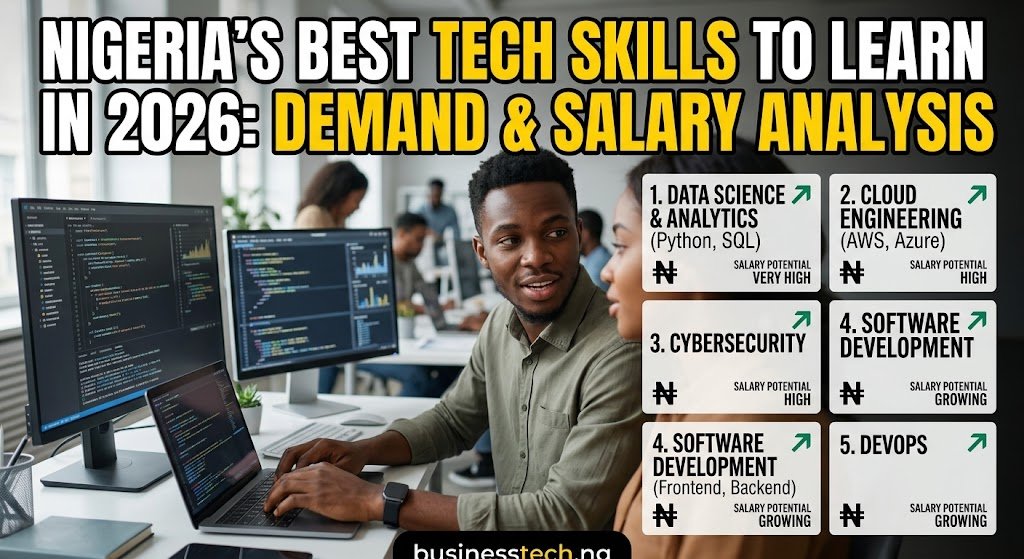
- Software development. The highest ceiling, tied to the JavaScript and Python demand covered above.
- UI/UX design. A genuine supply gap with a lower barrier to entry than coding.
- Data analysis. Cited as Nigeria’s fastest-growing tech demand area, tied to fintech and banking’s data needs.
- Cybersecurity. Described as an underserved opportunity across nearly every guide reviewed.
- Digital marketing. The lowest barrier tech entry point, combining creativity with measurable digital skills.
- Product management. A business-to-tech bridge role, valuable for people who understand both sides.
- DevOps and cloud engineering. A premium path due to acute shortage relative to demand.
- AI and machine learning. The frontier path, offering the highest pay ceiling for those who can reach it.
This ranking comes from a 2026 Nigerian tech career roadmap and should be read as one guide’s framing rather than an official ranking of career value.
Sector-by-Sector Demand
- Fintech and banking: The single largest driver of demand for Python, SQL, data analysis and business intelligence skills, since these companies need to turn transaction data into decisions.
- Telecoms: MTN, Airtel and Globacom maintain digital product teams needing designers and developers to improve subscriber-facing apps, connecting to the growth documented in our Nigerian telecom statistics report.
- Health tech and agritech: Increasingly listing machine learning skills at scale, tied to the wider tech ecosystem funding trends covered in our startup funding analysis.
- E-commerce and logistics: Competing for the same limited pool of designers and full-stack developers as fintech.
Outlook for 2027
Three shifts are likely to matter most going into next year:
- AI-adjacent, non-coding roles will keep expanding. Prompt engineering, AI workflow design and applied data science are newer fields with less competition than saturated coding bootcamp graduate pools.
- The DevOps, cloud and cybersecurity shortage will likely persist, since these skills take longer to develop and fewer Nigerian training providers focus on them compared with web development.
- Portfolio and demonstrable ability will matter more than credentials alone, as hiring managers already report frustration with candidates who have certificates but no real project experience or version control habits.
Frequently Asked Questions
What is the most in-demand programming language in Nigeria in 2026?
Globally, Python leads with about 45.7% of recruiters seeking it, but in the Nigerian market specifically, JavaScript and Node.js remain the most requested skill for full-stack and backend hires, with Python demand rising fast in data-related roles.
Can I get a tech job in Nigeria without learning to code?
Yes. UI/UX design, product management, digital marketing, prompt engineering and cybersecurity all offer paths into tech without deep programming knowledge, though cybersecurity often benefits from some technical grounding.
Which tech skill pays the most in Nigeria?
Skill combinations tend to pay more than single skills. Python plus machine learning plus SQL is cited as the top-paying data science stack, with experienced machine learning engineers earning ₦1 million to ₦3 million a month in some reports.
Is UI/UX design a good career in Nigeria in 2026?
Demand for qualified designers, especially mid and senior level, exceeds supply at many Nigerian companies, making it one of the more accessible tech entry points with genuine hiring gaps to fill.
What is prompt engineering and is it in demand in Nigeria?
Prompt engineering means crafting effective instructions for AI tools to get useful results. It rarely exists as a standalone job title but is increasingly embedded in marketing, content and product roles, and is considered a less saturated field in Nigeria.
Conclusion
Nigeria’s tech skills market in 2026 rewards two things above all: relevance to fintech and banking’s data needs, and the ability to prove skill through real projects rather than certificates alone. Python and JavaScript remain the foundational languages, but the biggest opportunities may lie in the gaps, DevOps, cybersecurity, UI/UX design and the emerging AI-adjacent, non-coding roles, where Nigerian supply has not yet caught up with demand.