|
Getting your Trinity Audio player ready...
|
Alibaba Shares Slide After $10.2 Billion AI Share Sale Offered at Sharp Discount
Alibaba just gave investors a very clear read on how expensive the AI race has become, and the market did not like the invoice. Shares of the Chinese e-commerce and cloud computing giant tumbled as much as 10 percent in Hong Kong trading after the company priced a record-breaking $10.2 billion stock placement at a steep discount, a move meant to bankroll its expanding artificial intelligence ambitions but one that immediately raised fresh questions about dilution and payoff timelines.
The mechanics of the deal are straightforward even if the reaction was not. Alibaba is issuing 710 million new shares at HK$112.70 apiece, raising a total of HK$80 billion, which converts to roughly $10.2 billion. That price sits 8.4 percent below the stock’s Friday closing level in Hong Kong and about 3.6 percent below the closing price of its New York-listed shares. When the news hit trading floors Monday morning, Alibaba’s Hong Kong stock opened sharply lower and stayed there, closing out the morning session down close to 10 percent before settling into an 8 to 9 percent decline for the day. It marked one of the steepest single-day drops for the stock in well over a year.
This is not a small transaction by any measure. It stands as the largest primary follow-on offering ever completed by a Hong Kong-listed company, and globally it ranks as the third-biggest capital raise of the year, trailing only Alphabet’s roughly $85 billion raise and Intel’s $20 billion offering. That context matters, because it places Alibaba’s AI spending squarely alongside the biggest names in American tech, at a moment when investors on both sides of the Pacific are asking the same uncomfortable question: when does all this capital expenditure actually turn into profit.
Summary:
- Placement price of HK$112.70 is 8.4% discount to Friday’s close
- Order book draws robust demand of $28 billion, sources say
- Investors see AI spending as necessary but fret about execution risks

Alibaba has been unambiguous about where the money is going. The company said every dollar of net proceeds will be funneled into what it calls its full-stack AI capabilities, covering everything from custom chip development to data center buildout to the underlying AI models themselves. This isn’t a new commitment so much as an acceleration of one. Alibaba pledged last year to spend at least 380 billion yuan, or roughly $56.5 billion, on AI and cloud infrastructure over three years, and recent earnings disclosures show the company has already burned through nearly half of that budget. Capital expenditure alone jumped 75 percent in the most recent quarter to 67.7 billion yuan, a pace of spending that has visibly strained the balance sheet.
That strain showed up in Alibaba’s most recent earnings report, released just days before the share sale, which revealed a 75 percent year-over-year drop in quarterly net profit. The company also posted a $6.6 billion free cash outflow during the period, a figure that underscores just how much cash AI infrastructure is consuming even as the payoff remains largely theoretical for now. Notably, Alibaba has told investors it now expects to recoup its AI investment in two and a half years rather than the three years it originally projected, citing surging demand for its AI services as the reason for the shortened timeline. Whether that optimism holds up will likely shape sentiment around the stock for months to come.
Market reaction to the discount itself has been mixed but leans skeptical. Analysts and fund managers quoted in the wake of the announcement pointed to two separate concerns working in tandem. The first is straightforward dilution: issuing 710 million new shares, equivalent to roughly 3.7 percent of Alibaba’s enlarged share count of about 19.17 billion shares, spreads existing ownership thinner. The second is a broader unease about heavy capital spending generally, a sentiment that has been building across global tech markets as companies from Microsoft to Meta to Alibaba all pour unprecedented sums into AI infrastructure with return timelines that remain difficult to pin down. One Shenzhen-based asset manager summed up the mood bluntly, noting that the placement dilutes shareholder interest in the near term even if the underlying investment case has long-term merit.
Not everyone views the move as purely bearish, though. Demand for the offering was reportedly strong, with orders totaling around $28 billion against the $10.2 billion on offer, nearly three times oversubscribed according to people familiar with the deal. Roughly 40 percent of the shares are said to be going to long-only and sovereign wealth investors, the kind of buyers who tend to hold positions for extended periods rather than trading around short-term price swings, which could help cushion further downside pressure once the immediate dilution shock wears off. Some observers have also framed the deal as evidence that global capital remains willing to bet on Chinese AI ambitions even amid ongoing US-China tech tensions, with one NYU law professor describing the willingness of sovereign investors to participate as a sign that big institutional money is compartmentalizing geopolitical friction rather than letting it dictate allocation decisions.
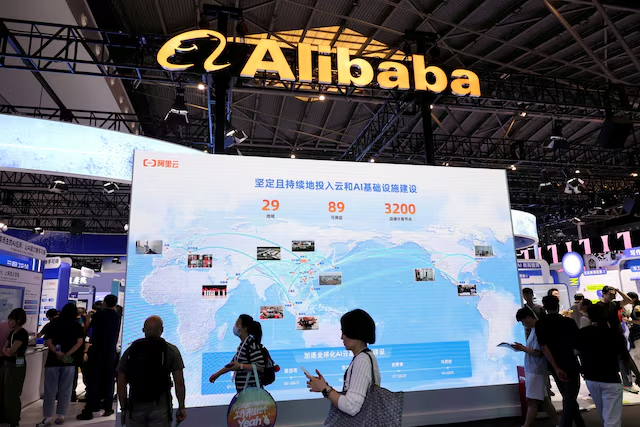
The timing adds another layer to the story. Alibaba’s fundraising lands just a week after its Alibaba Cloud division opened a third data center in South Korea, expanding its global network to 104 availability zones across 30 regions, a reminder that the company’s AI ambitions extend well beyond its home market. Alibaba has increasingly positioned its cloud and AI businesses as the primary growth engine for the company going forward, a strategic pivot away from the e-commerce roots that built its fortune, even as some skeptics question whether a company built on retail logistics can genuinely out-innovate dedicated AI and chip specialists over the long run.
For now, the HK$112.70 price tag on this placement may end up functioning as something of a psychological anchor for the stock. Large discounted share sales like this one often create a short-term gravity point in the market, with investors treating the offer price as the freshest indicator of where genuine demand sits, and trading the stock around that level until the new supply gets absorbed. Whether Alibaba’s shares stabilize above or below that mark in the coming weeks will say a lot about how much patience the market still has for the AI spending race, and whether Alibaba’s accelerated payback timeline turns out to be confidence or wishful thinking. Investors watching the broader AI infrastructure buildout across the industry can find ongoing coverage of these capital raises and their market impact on Techora’s technology business desk.